


What the research says about home solar, batteries and cyberattacks, in plain English.
By Uday Singh, Founder and Chief Executive Officer of EL-FI Homes, who researched and reviewed this article. He is a Master of Science student at Arizona State University, holds an MBA from UCLA Anderson and previously worked in product management.
Quick answer
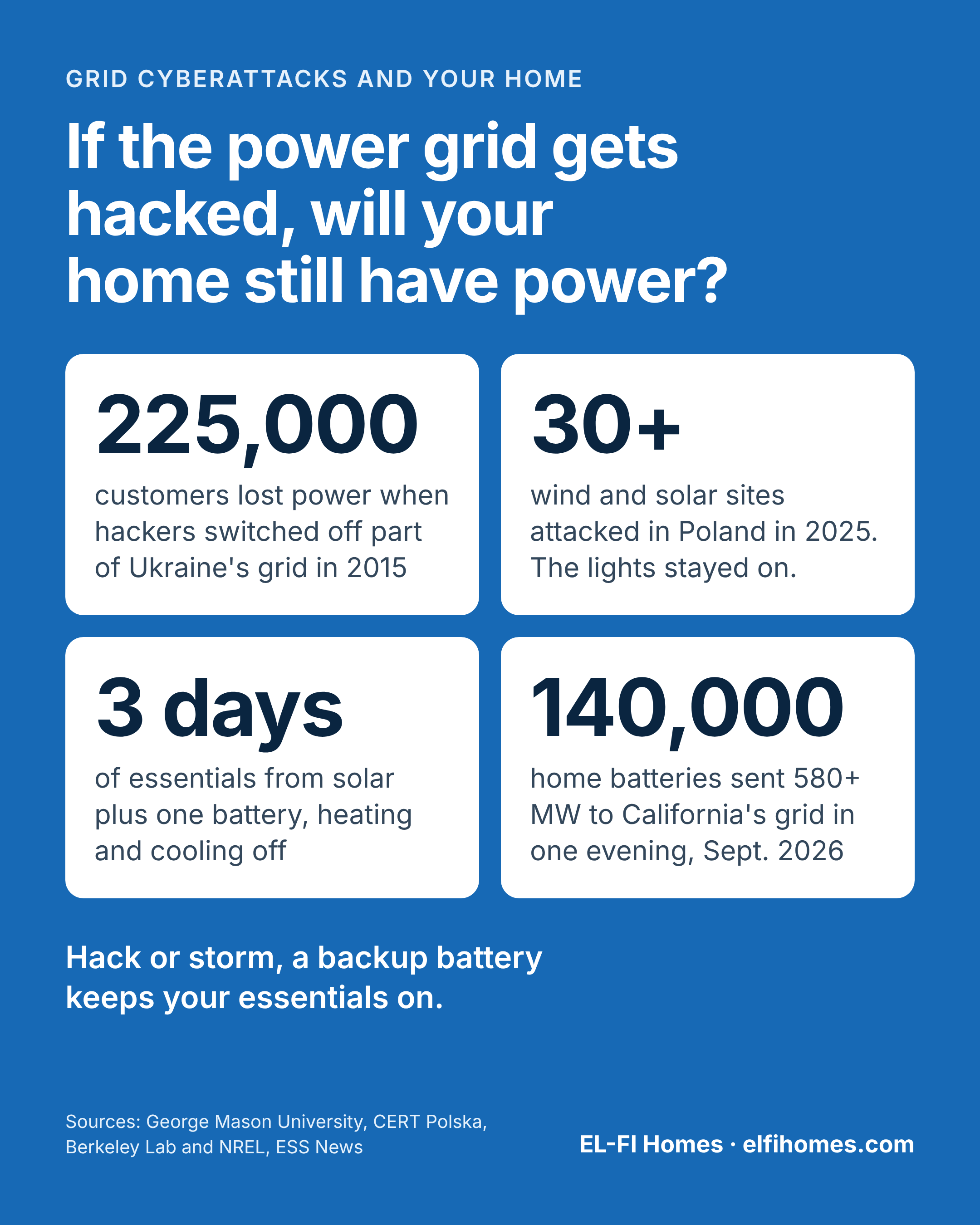
- Yes, power grids can be hacked. It has happened. In 2015, attackers switched off power to about 225,000 customers in Ukraine.
- A properly configured solar and backup battery system can keep essential circuits running during an outage. National lab modeling found that solar plus a modest battery could cover basic loads through a three-day outage in nearly every modeled U.S. county and month, without heating or cooling. Actual performance depends on conditions.
- Solar panels alone will not do it. Without a battery set up for backup, a standard solar system shuts off when the grid does.
- Your system needs basic security too. It connects to the internet, so passwords and updates matter. A 10-minute checklist is below.
Most blackouts are still caused by weather, not hackers. Backup power protects you from both in the same way.
How the grid works, and why that matters
Most electricity still travels one way. Large power plants make it. High-voltage lines carry it to neighborhood substations, which send it down your street.
That design has worked for a century, but it has one weakness. A small number of control points serve a very large number of homes. Whoever controls a substation controls the lights for everyone downstream.
Think of a town that gets all its water from one tower. If someone closes the tower's valve, every tap runs dry at once. Now give each home its own full tank. The tower still matters, but closing the valve no longer leaves everyone without water.
A home battery is that tank. Solar panels are the rain that refills it.
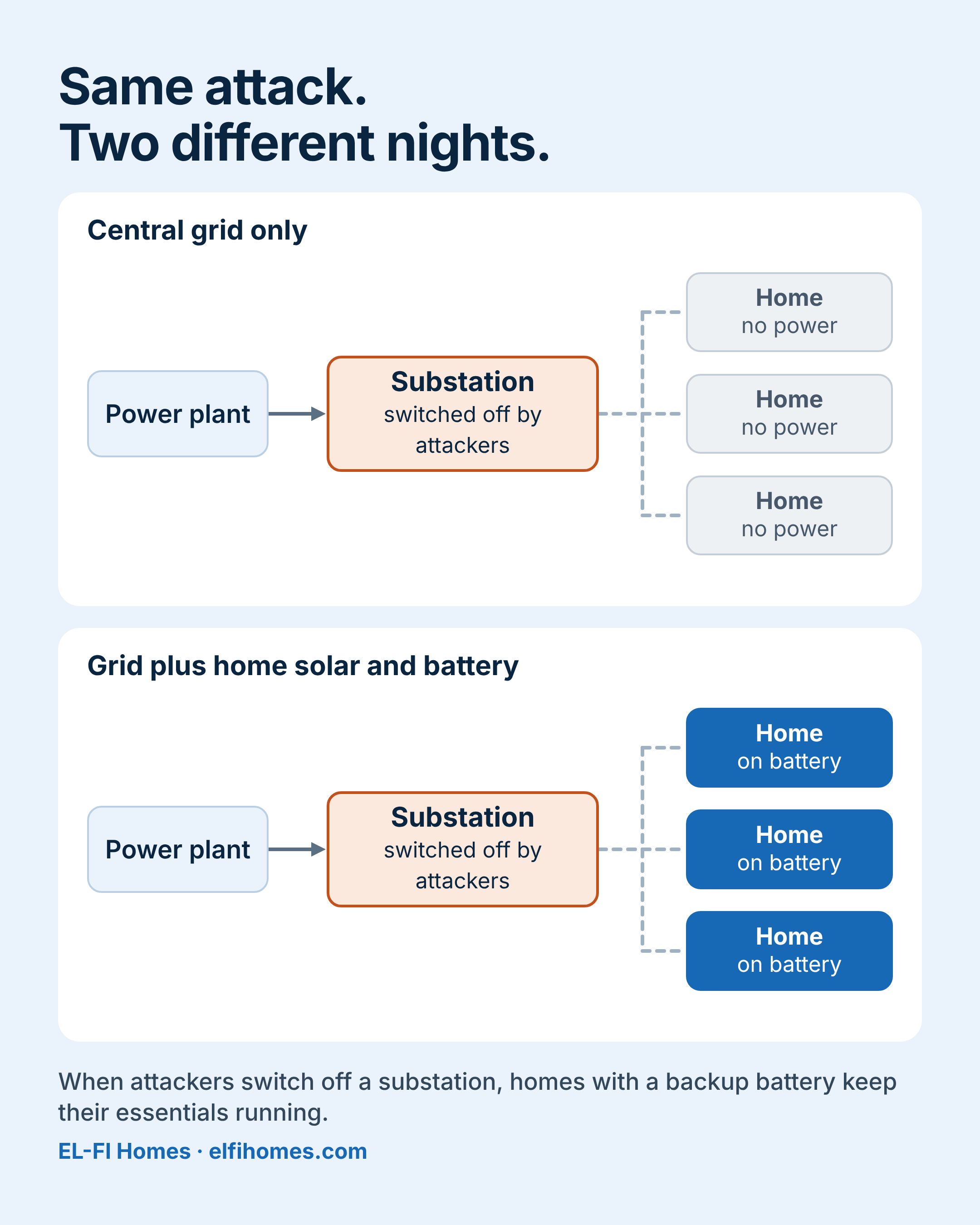
In both pictures the attack is the same. The only difference is whether each home has its own stored power to fall back on.
Has a power grid really been hacked?
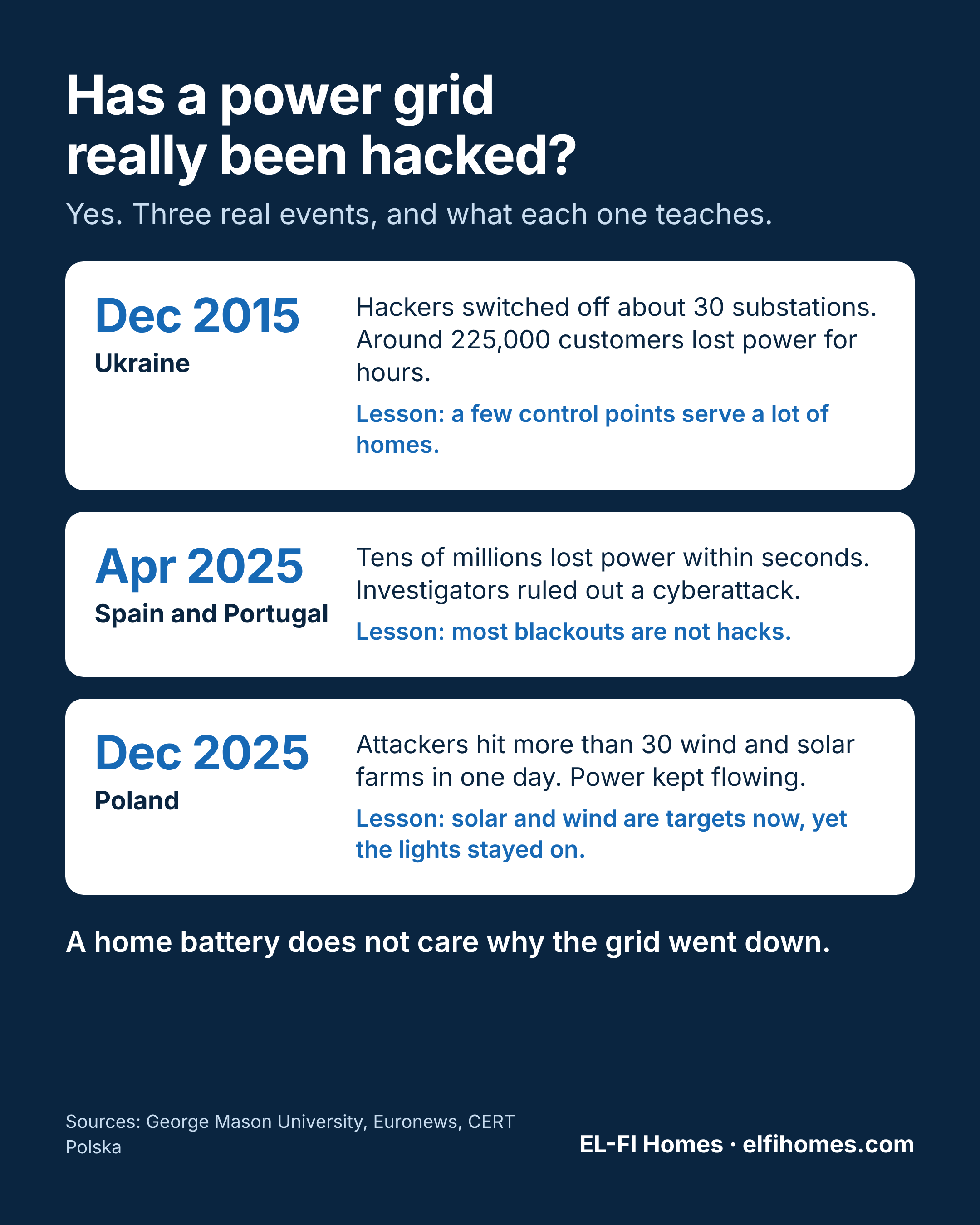
Yes. Three recent events show what is real and what is rumor.
Ukraine, 2015: hackers turn off the lights
On December 23, 2015, attackers who had spent months inside three Ukrainian power companies took over the operators' computers. They switched off about 30 substations, and roughly 225,000 customers lost power. Most had it back in under six hours, according to a George Mason University analysis.
Poland, 2025: attackers go after solar and wind
On December 29, 2025, a coordinated attack hit more than 30 wind and solar farms and a large heat and power plant in Poland. The attackers damaged control equipment and cut the sites off from remote control. Electricity production continued and no heat was lost, according to CERT Polska, the country's cyber response team.
Two things stand out. Attackers now aim at renewable energy, not only at old power plants. And even with 30 sites hit on the same day, the lights stayed on.
Spain and Portugal, 2025: a giant blackout that was not a hack
On April 28, 2025, tens of millions of people in Spain and Portugal lost power within seconds. Many assumed hackers were behind it. Spain's official investigation ruled out a cyberattack and blamed technical failures and poor planning, as Euronews reported.
What this means for a homeowner
Most blackouts are not caused by hackers. Storms, heat, equipment failures and wildfire safety shutoffs are far more common.
Southern California saw this in January 2025. On one afternoon during the windstorms, 413,639 Southern California Edison customers were without power, about 183,000 of them because of planned safety shutoffs, T&D World reported.
Nationally, customers averaged about 11 hours without power in 2024, and major events such as hurricanes caused about 80% of it, according to the U.S. Energy Information Administration. A battery does not care why the grid went down.
What AI changes
Breaking into a power company used to take a skilled team many months. AI tools can now do parts of that work faster, and for people with less skill. Three reports from 2026 show where things stand.
- U.S. agencies, August 2026. Five agencies, including the NSA, the FBI and the Department of Energy, warned that attackers were using AI-written scripts to probe industrial control equipment. Energy was among the sectors targeted. No disruption was confirmed; the agencies described scouting and preparation, according to the joint advisory AA26-231A.
- Security firm Frenos, October 2026. Across 16,980 simulated tests, the three strongest AI models produced workable plans for attacking industrial systems in about 90% of planning attempts. These were simulations, and the plans sometimes skipped steps. "We still think human judgment remains essential," the firm's technology chief told The Register.
- UK cyber agency, November 2026. Britain's National Cyber Security Centre said attackers' use of AI is "highly likely" to increase the scale of attacks over the next two years. It told operators of essential services to prepare for AI-powered ransomware by 2028.
None of these reports describes a blackout caused by AI. What they describe is a falling price of admission: less skill and less time are needed to try.
That is a reason to prepare calmly, not to panic. It makes having your own backup more valuable.
What happens at your house when the grid goes down
Solar panels alone will not keep your lights on. To protect utility crews, a standard solar system shuts off when the grid loses power. To keep running, a home needs battery storage and the right equipment, as the U.S. Department of Energy explains.
With a battery and the right backup equipment, your home can disconnect safely from the grid during an outage. Installers call this “islanding”: your home becomes its own small island of power. Compatible solar can recharge the battery by day, and the battery can carry essential loads through the night, subject to available energy and conditions.
How long can it last?
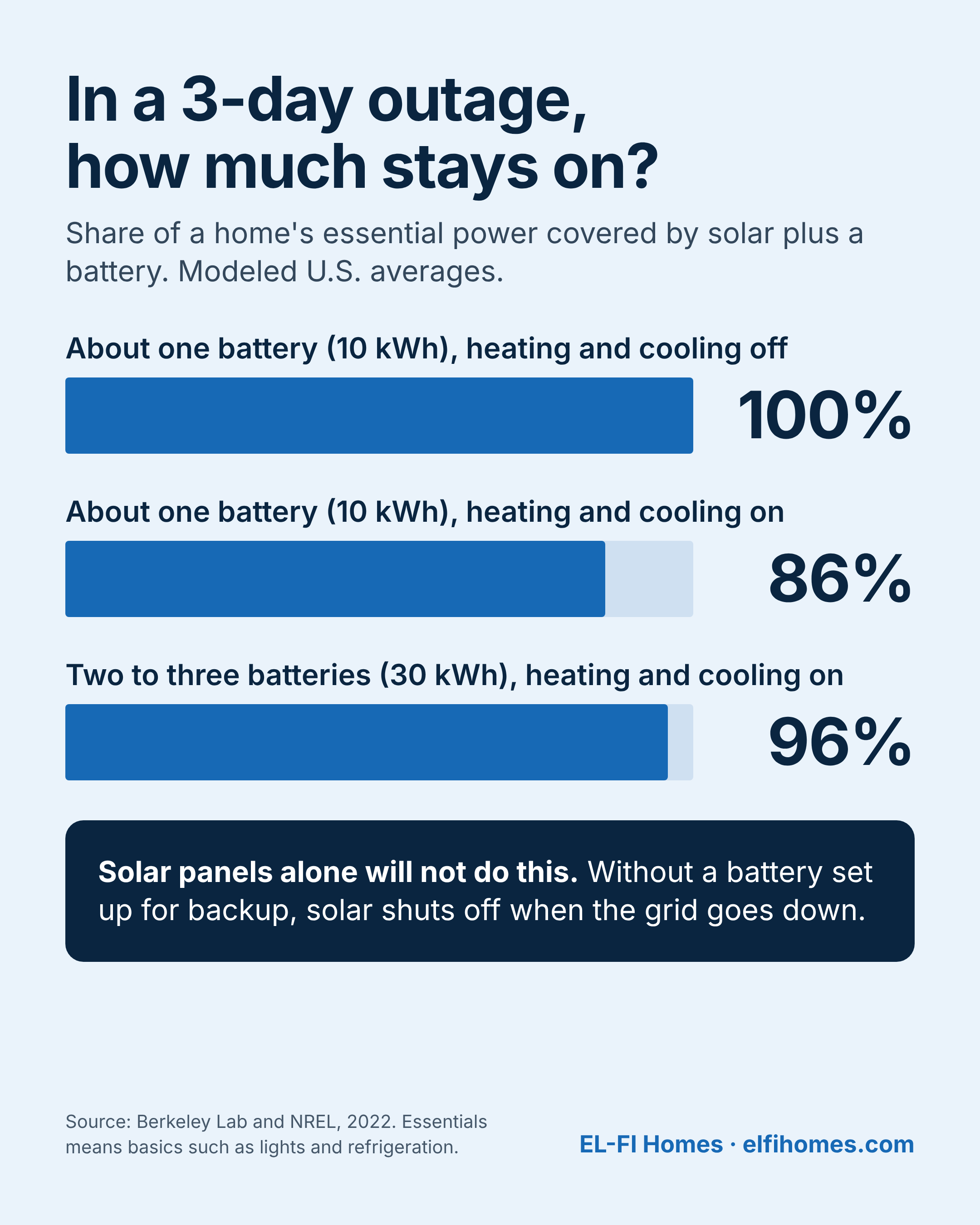
Berkeley Lab and the National Renewable Energy Laboratory modeled homes in every U.S. county through three-day outages. "Essentials" here means basics such as lights and refrigeration. The percentages below are averages of critical-load energy served across modeled counties and months, not the share of homes guaranteed to maintain full power.
| Home setup | Average critical-load energy served in a modeled 3-day outage |
|---|---|
| Solar + 10 kWh of battery, no heating or air conditioning | Nearly all basic loads in virtually every modeled county and month |
| Solar + 10 kWh of battery, heating and air conditioning included | About 86% |
| Solar + 30 kWh of battery, heating and air conditioning included | About 96% |
For scale, a Tesla Powerwall 3 stores 13.5 kWh and an Enphase IQ Battery 10C stores 10 kWh. The first two rows describe roughly one battery. The last row describes two or three.
The researchers also replayed ten real long outages using 30 kWh of storage. In seven of them, most homes kept their essentials running. In four, including California's wildfire safety shutoffs, every modeled home did.
What about short, everyday outages?
A second Berkeley Lab study simulated short outages in representative homes in three U.S. counties. Solar with a 10 kWh battery fully covered essential loads, excluding heating and cooling, in 84% of simulated events and supplied an average of 93% of the energy needed across those events.
Where batteries fall short
- Hurricanes did worst in the research, because clouds cut solar output for days.
- Homes with electric heating struggled in winter storms.
- The studies did not count storm damage to the panels or batteries themselves.
- Not every battery is installed for backup. Some are set up only to lower bills and shut off with the grid. If outage protection matters to you, say so before your system is designed.
Can home batteries help everyone, not just you?
Researchers think so, and California has started to show it.
The MIT study
In 2025, engineers at MIT and partner institutions published a study in the Proceedings of the National Academy of Sciences. They simulated attacks on a local grid. In one, hackers push every smart thermostat from one manufacturer to change its setting at the same moment.
The team then tested whether nearby rooftop solar, home batteries, EV chargers and smart thermostats could fill the gap, by sending power or by using less. Across the scenarios, which removed 5 to 40 percent of power, the coordinated devices steadied the grid every time.
"All these small devices can do their little bit," said co-author Anu Annaswamy of MIT. She also called the work an early step. It still needs homeowner sign-ups, supportive rules and real-world trials.
The California test
On July 29, 2025, home batteries across California were asked to send power to the grid at the same time. For two hours they delivered 535 megawatts, working together as what PG&E called "one giant, invisible power plant."
The industry term is a virtual power plant: many home batteries coordinated by software to act like one power station. In September 2026, a real call during a heat wave passed 580 megawatts from roughly 140,000 home batteries, ESS News reported.
Neither event was a response to a cyberattack. They show something simpler: thousands of small batteries can act together, on request, at the scale of a power plant.
The honest downside: your solar system is also a small computer
Every solar and battery system has an inverter, the box that turns solar power into the kind your home uses. It connects to the internet so you can watch your system in an app and so the manufacturer can send updates. Anything connected to the internet can be attacked.
Researchers have said so for years:
- Scientists at Argonne National Laboratory and Washington State University warned in 2016 that as home energy devices multiply, so does the risk of cyberattack.
- A 2024 review in a leading engineering journal agreed. Software-run solar and storage, spread over a wide area, are exposed to hardware flaws, software flaws and human error.
- Princeton researchers showed in simulations what could happen if attackers took over many power-hungry smart appliances at once, such as air conditioners. The result could be local outages and, in the worst cases, large blackouts.
- In 2025, security firm Forescout found 46 new flaws in equipment from three major inverter makers. Some would have let an attacker control systems through the manufacturer's online service. All three companies have fixed them.
How worried should you be?
The U.S. Department of Energy's view is measured. In its 2022 review, it said an attack on today's home solar and battery systems would have a "negligible impact on grid reliability." Its concern is the future, as millions more systems come online. That is why it wants security built in from the start.
Two points matter for homeowners:
- One home cannot take down the grid. The risk researchers study is thousands of identical devices being controlled at once.
- The weak point is rarely the panels or the battery. It is usually the app, the password and the manufacturer's online service.
So which is safer: one big grid or many small sources?
For your own home, solar with a properly configured backup battery can provide power to selected circuits when the grid fails. Actual runtime depends on equipment, loads, battery charge and solar generation.
For the grid as a whole, the fair answer is that it depends on how well the small systems are secured.
| Central grid only | Grid plus home solar and battery | |
|---|---|---|
| What an attacker has to reach | A small number of utility control systems | Many separate homes and several manufacturers' online services |
| Worst case from one successful attack | A whole region dark at once | Limited to the brands or services that were breached |
| What you have during an outage | Nothing | Hours to days of essential power |
| New weak spot | None at your home | An internet-connected inverter and app |
| Who keeps it secure | The utility | The manufacturer, your installer and you |
Sandia National Laboratories weighed both sides in a 2025 report. It looked at reasons a fully spread-out system might fall short, and reasons a central one might hold up better. Among its conclusions: batteries placed at the buildings they serve can act as each building's own backup supply.
One honest limit: we found no study that measures how much one home's system lowers the grid's hacking risk. Be careful with anyone who quotes you a number.
The evidence suggests distributed backup can help individual homes ride through some grid outages. Its effect on wider grid resilience depends on system design, coordination and cybersecurity.
A 10-minute security checklist
You do not need to be technical. Each step takes a few minutes.
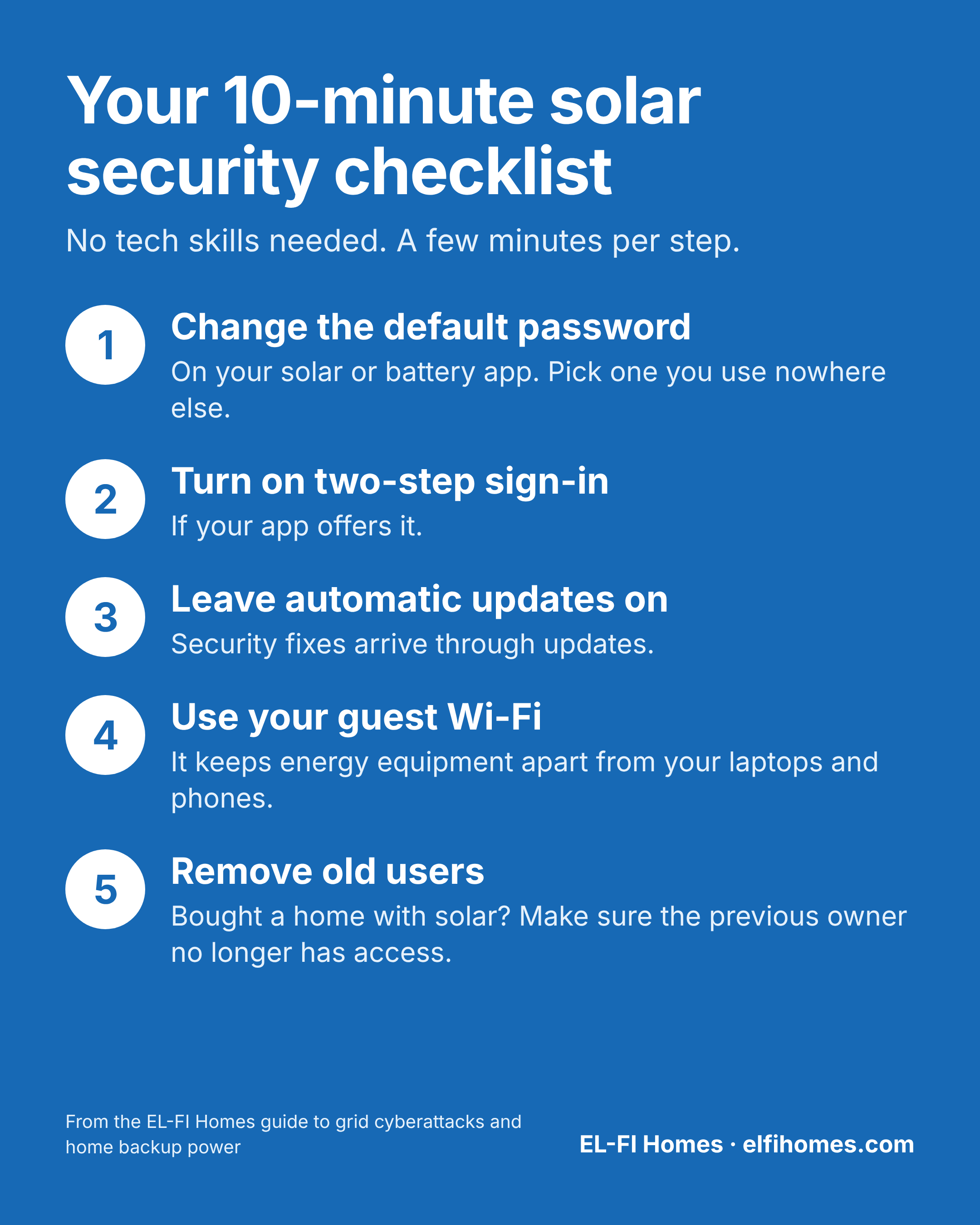
- Change the default password on your solar or battery app. Use one you do not use anywhere else.
- Turn on two-step sign-in if the app offers it.
- Leave automatic updates on. The 2025 inverter flaws were fixed through updates.
- Use your guest Wi-Fi for energy equipment if your router has one. That keeps it apart from your laptops and phones.
- Remove old users. If you bought a home with solar already installed, make sure the previous owner no longer has access.
Five questions to ask any installer
- If the grid goes down, will this system keep my home running, and which circuits?
- Will backup still work if my internet is down?
- Who can control or update my system remotely: the manufacturer, the installer, the utility or a finance company?
- How does the manufacturer deliver security updates, and for how many years?
- Has the equipment been tested to a recognized security standard, such as UL 2941?
Want to see what backup could look like for your home? Start with EL-FI's solar and battery estimate.
Common questions
Can the U.S. power grid be hacked?
It has happened in other countries, and U.S. agencies say attackers are probing American systems. The 2026 warning we reviewed described probing, not a confirmed outage.
Do solar panels work during a blackout?
Not by themselves. You need a battery set up for backup.
Can someone hack my home solar system?
It is possible, mainly through the app or the manufacturer's online service. A strong password, two-step sign-in and automatic updates go a long way.
Could my system be used to attack the grid?
One home cannot affect the grid. Researchers worry about very large numbers of identical devices being controlled together, which is why manufacturer security matters.
How much battery do I need for a three-day outage?
In one national lab model, solar with 10 kWh of storage covered most essential loads without heating or cooling in a three-day outage. With heating and cooling included, 30 kWh supplied an average of 96% of critical-load energy across modeled counties and months. Your needs depend on your home and conditions.
Is going fully off-grid safer?
Usually not. Staying connected keeps the grid as a second source of power, and a backup battery covers you when it fails.
Words to know
- Inverter: the box that turns solar power into the kind your home uses.
- Backup gateway: the switch that disconnects your home from the grid during an outage, so the battery can power it safely.
- Islanding: running your home on its own solar and battery while the grid is down.
- kWh (kilowatt-hour): a measure of stored energy. Common home batteries hold 10 to 13.5 kWh.
- Virtual power plant: many home batteries coordinated by software to support the grid together.
- Firmware update: a software update for a device, like the ones your phone installs.
About EL-FI Homes
EL-FI Homes (CSLB license #1113934; C10, C20 and C46) installs solar, Tesla and Enphase battery systems, EV chargers, panel upgrades and heat pump HVAC across Los Angeles, Orange, Riverside and San Bernardino counties.
References
Research studies
- Gorman et al., Evaluating the Capabilities of Behind-the-Meter Solar-plus-Storage for Providing Backup Power during Long-Duration Power Interruptions, Lawrence Berkeley National Laboratory and NREL, 2022
- Baik et al., Assessing the Performance of Behind-the-Meter Solar+Storage for Short-Duration Power Interruptions, Lawrence Berkeley National Laboratory
- Nair et al., Resilience of the Electric Grid through Trustable IoT-Coordinated Assets, Proceedings of the National Academy of Sciences, 2025; MIT summary
- Qi, Hahn, Lu, Wang and Liu, Cybersecurity for distributed energy resources and smart inverters, IET Cyber-Physical Systems, 2016
- Liu et al., Enhancing Cyber-Resiliency of DER-based Smart Grid: A Survey, IEEE Transactions on Smart Grid, 2024
- Soltan, Mittal and Poor, BlackIoT: IoT Botnet of High Wattage Devices Can Disrupt the Power Grid, USENIX Security Symposium, 2018
- Ropp, An exploration of how the geographic distribution of power sources impacts power system resilience, Sandia National Laboratories, 2025
Government and official sources
- U.S. Department of Energy, Solar and Resilience Basics
- U.S. Department of Energy, Cybersecurity Considerations for Distributed Energy Resources on the U.S. Electric Grid, October 2022
- CERT Polska, Energy Sector Incident Report, 29 December 2025, January 2026
- UK National Cyber Security Centre, Annual Review 2026 announcement, November 2026
- U.S. Energy Information Administration, Hurricanes in 2024 led to the most hours without power in 10 years, December 2025
- Pacific Gas and Electric, California's biggest battery test, August 2025
Reporting and industry research
- George Mason University Center for Infrastructure Protection, Lessons learned from the power outage in Ukraine, 2016
- Euronews, Spain rules out cyberattack in April blackout, June 2025
- T&D World, Edison International shares latest on wildfires and power outages, January 2025
- Security Affairs, Agencies warn of AI-assisted attacks on Siemens S7 controllers (advisory AA26-231A), August 2026
- The Register, Frenos study of AI models planning industrial attacks, October 2026
- Forescout Vedere Labs, SUN:DOWN research announcement, March 2025
- ESS News, California home batteries set dispatch record during heat wave, September 2026
This article is general education, not a security assessment of any specific system. Backup performance depends on your home, your equipment and how it is set up. Final designs are confirmed after an EL-FI Homes site visit.