


Start with your utility and your actual rate plan
A battery can reduce electricity purchases when storing solar is worth more than exporting it. That depends on when your utility nets energy, what it pays for exports, and what you pay later. A low annual surplus payment does not mean every daytime export earns that low rate.
For new SCE and SDG&E Solar Billing Plan customers, exports are usually credited below retail purchase prices. Some late-summer evening exports can be more valuable. Storage can help shift energy to useful hours, but a battery is not universally required. Existing NEM customers need a separate analysis. Read the CPUC’s net billing explanation.
| Utility and program | What the current rules mean | Battery takeaway |
|---|---|---|
| SCE and SDG&E New Solar Billing Plan | Time-varying export credits differ from retail import prices. | Often a strong reason to model storage. Use interval usage, hourly credits and the actual rate plan. |
| Pasadena Water and Power | Annual, monthly or bi-monthly net-metering options; surplus compensation follows the selected netting period. | Case by case. Check the netting option, remaining charges, backup needs and current battery incentives. |
| Glendale Water and Power | Net metering measures the difference between energy delivered and consumed within the billing period. | Do not assume storage is needed simply to offset nighttime energy. Check the customer’s tariff and surplus treatment. |
| LADWP Service Rider NEM | Billing-period netting and energy credits based on the applicable rate schedule; unused credits carry forward under program rules. | Daily solar shifting may add less bill value than under net billing. Backup and time-of-use needs can still justify storage. |
| Anaheim Public Utilities Current NEM 2.0 | Anaheim describes its current program as wholesale-based. This is different from the investor-owned utilities’ legacy NEM 2.0. | Storage can be worth modeling. Review current export rates; grandfathered NEM 1.0 customers have different rules. |
| Burbank Water and Power New 2026 solar program | Solar Net Billing began January 1, 2026. Eligible new projects receive avoided-cost export credits; grandfathered NEM customers retain their program. | New and grandfathered customers need different analyses. New net-billing customers should evaluate storage. |
| Riverside Public Utilities Self-Generation Program | Residential customers use a time-of-use rate. Export credits use avoided energy costs and applicable time-of-delivery factors. | Another local program where export value and later purchase costs can favor storage. Legacy NEM is separate. |
Our conclusion: SCE and SDG&E’s new plans often strengthen the storage case, but Anaheim and new Burbank customers should not be put in a “battery not needed” category. Pasadena and Glendale should not be labeled “battery required.” LADWP customers still need a backup and rate-plan assessment.
Outside Southern California, PG&E’s Solar Billing Plan follows the same broad state net-billing framework. Customers served by a community choice aggregator should check that provider’s generation credits as well.
How a battery can change your electricity bill
During the day, solar can supply the home and charge the battery. Later, stored energy can replace electricity you would otherwise buy. In an outage, a properly configured backup system can supply selected loads while safely isolated from the grid. See how backup and non-backup configurations differ.
- Daytime: Solar → home + battery
- Evening: Battery → home
- Outage: Configured backup → selected loads
The bill benefit is the cost of purchases avoided minus the export credit you give up. Charging and discharging lose some energy. For an illustrative 10 kWh of solar diverted to storage, 90% round-trip efficiency delivers 9 kWh later. At a 45¢ purchase price and a 5¢ export price, the gross incremental value is $4.05 − $0.50 = $3.55.
These are teaching assumptions, not any utility’s quoted rates. In net-metering programs, apply the actual billing-period rules before using this calculation. When daytime credits already offset later purchases, storage may add little bill value.
Ask for a model using 12 months of bills and interval usage. Include actual export timing, charging limits, battery degradation, remaining utility charges, installation cost and financing. Confirm incentive eligibility and funding before subtracting a rebate. Gross energy value is not net savings or a payback guarantee.
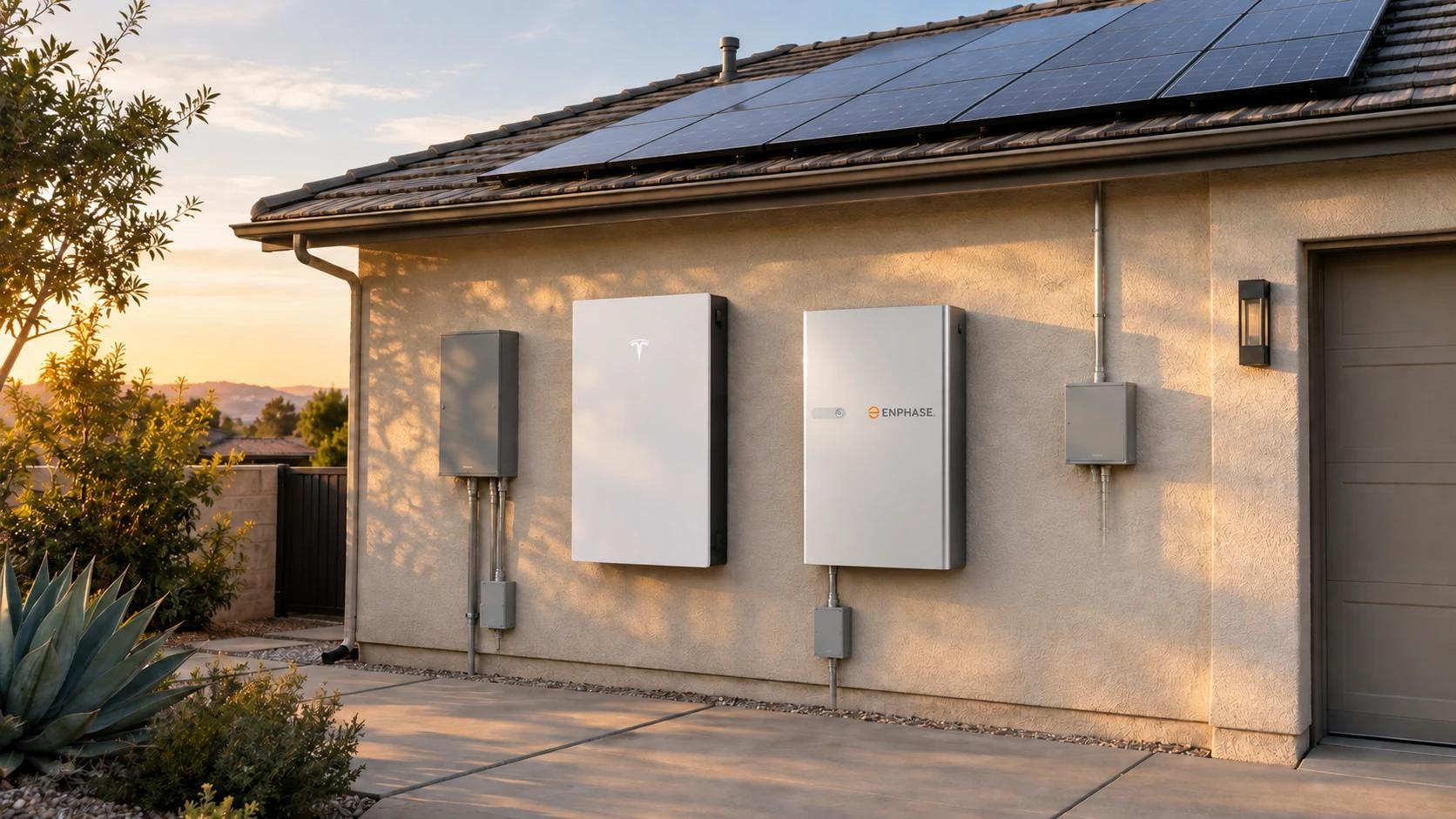
Enphase and Tesla compare the exact system
Capacity in kilowatt-hours (kWh) describes stored energy. Power in kilowatts (kW) describes how much equipment can run at once. A battery needs enough of both. Here are representative US models; verify the exact equipment and commissioning settings on your proposal.
| Model | Usable / nominal energy | Continuous output at 240 V | Design consideration |
|---|---|---|---|
| Enphase IQ Battery 5P | 5.0 kWh per unit | 3.84 kW | Modular AC-coupled storage. Two units provide 10 kWh; approved system design determines combined power. |
| Enphase IQ Battery 10C | 10.0 kWh per unit | 7.08 kW | A larger Enphase AC-coupled option. Check controller and system compatibility. |
| Tesla Powerwall 3 | 13.5 kWh per unit | Up to 11.5 kW in the standard configuration | Integrated solar inverter. Output depends on commissioning. An energy expansion unit does not add another full inverter’s power. |
One 5P, one 10C and one Powerwall 3 have different capacities, so their runtimes are not an equal-size brand comparison. Compare the complete quote: usable energy, continuous and motor-starting power, backup equipment, existing solar compatibility, installation scope and service.
Enphase’s cited 5P and 10C warranties run to the earlier of 15 years or 6,000 discharged cycles. Tesla’s US Powerwall warranty specifies 10 years and 70% retained energy, with operating limits depending on use. Review exclusions and who pays diagnosis, labor, shipping and replacement costs.
How much shorter is runtime when you add loads
With no recharging, runtime is approximately available energy divided by average load. If 10 kWh is available to appliances after operating limits and losses, a 0.5 kW average load lasts about 20 hours; 2 kW lasts 5 hours; 5 kW lasts 2 hours. Doubling the load roughly halves the runtime.
Refrigerators and air conditioners cycle, and motors need extra power to start. Use measured or estimated average demand for runtime, then check the highest simultaneous and startup demand separately. Whole-home wiring does not mean unlimited whole-home power.
The calculator uses rated energy, the chosen charge range and a capacity-retention assumption. It does not simulate standby consumption, temperature, cycling appliances or solar recharge. It is a sizing conversation starter, not an outage-duration promise.
Spacing and installation restrictions come before convenience
For typical California one- and two-family homes, the 2026 state permitting guide describes a general 3-foot separation between units and a general 3-foot distance from exterior batteries to doors and windows that open directly into the dwelling. Reduced distances depend on the equipment’s listing and installation instructions; local amendments and approval still matter. Read the California Energy Storage Permitting Guidebook.
A “UL 9540A tested” statement is not blanket permission for any layout. The listed system, exact model instructions and approved plans govern the installation. Fire separation, electrical working space and manufacturer service access are different checks.
For projects under the Los Angeles County Fire Department’s PV and storage process, required review and inspection still apply, including qualifying expedited projects. We plan around the applicable fire requirements, access, required labels and disconnects. Garage locations may also require vehicle-impact protection and appropriate detection provisions. Confirm the current local rules before choosing a wall.
Why battery location changes the installed price
A longer wire route usually adds conductor, conduit and labor. The actual route matters more than straight-line distance: a nearby wall across a driveway can cost more to reach than a farther wall along an accessible exterior path.
| Site condition | What can increase the scope |
|---|---|
| Short, accessible route near the panel | Often less wiring and labor, if the location also meets clearance, mounting and access requirements. |
| Longer conduit run or difficult wall route | More material, supports, bends, penetrations and installation time. Electrical design may require larger conductors. |
| Trenching or crossing hardscape | Excavation, underground routing, concrete or paving work and restoration. |
| Remote or constrained location | Possible mounting work, protection, communications routing or additional access work. |
There is no reliable universal “dollars per extra foot” price. Ask for an itemized scope showing the proposed route, trenching, surface repairs, backup controls and any panel work. The cheapest mounting spot is not necessarily the best place to operate and service the system.
EL-FI Homes plans for service after installation
Our preference is an accessible outdoor installation when the equipment and site allow it. That can make inspection, troubleshooting and future service easier without needing access through living spaces. Outdoor placement is not automatically right for every home: we evaluate heat, direct sun, water exposure, flooding risk, vehicle exposure and the manufacturer’s environmental limits.
At EL-FI Homes, we plan the battery location and service route before installation, keep required access clear, document the equipment and wiring, and walk homeowners through monitoring and shutdown information. Equipment should remain reachable for service without moving storage items or blocking required exits. For example, Tesla’s Powerwall 3 care guidance calls for keeping airflow openings clear.
EL-FI Homes reports a 100% battery-inspection pass rate with the Los Angeles County Fire Department. This is a company-reported record provided by owner Uday Singh in September 2026. Good documentation, accessible equipment and attention to the approved design support our inspection process; each project still requires its own approval.
Do not leave a depleted battery disconnected indefinitely
Lithium-ion batteries, including lithium iron phosphate batteries, can suffer damage from deep over-discharge during prolonged unpowered storage. Enphase’s decommissioning guidance warns that storage-related over-discharge can damage or destroy the battery.
This does not mean normal daily cycling, a routine outage or a 0% reading in an app proves the battery is ruined. Battery-management systems control operating limits. The concern is leaving equipment depleted and without an approved way to recharge for an extended period.
If a remodel, service disconnection or installation delay will leave the system unpowered, contact the installer first. Storage charge levels, switch positions and re-energizing deadlines are model-specific. Keep up with alerts and arrange service if the battery stays offline or cannot recharge. Do not open the enclosure or try to “jump-start” a home battery.
Know who controls the battery
Ask your installer to demonstrate app access, daily operating modes, monitoring and backup reserve. A higher reserve keeps more energy available for outages and less available for routine bill management. Reserved energy becomes available during an outage; it is not the same as the calculator’s chosen stopping level. See Tesla’s reserve explanation.
Also ask who can remotely dispatch the battery and what opt-out rights apply. Paying cash, financing, leasing or choosing a prepaid PPA does not by itself establish the control rights. Read the equipment configuration, utility program and agreement together.
Get a battery plan for your home
Bring your electricity bills, existing solar details and a list of the appliances you want backed up. EL-FI Homes can compare the bill-savings case with the backup design, identify an accessible installation location and explain the complete scope before recommending equipment.
Explore EL-FI Homes solutions or request a home battery assessment. We serve Los Angeles, Orange, Riverside and San Bernardino counties.
About the author: Uday Singh is the owner of EL-FI Homes. He holds a master’s degree in Alternative Energy Science from Arizona State University and an Executive MBA from UCLA Anderson, with prior product management experience in the energy industry.
Utility programs and equipment requirements can change. This review uses linked official sources available September 16, 2026. Confirm the customer’s current tariff, equipment listing and local permit requirements for the proposed project.