


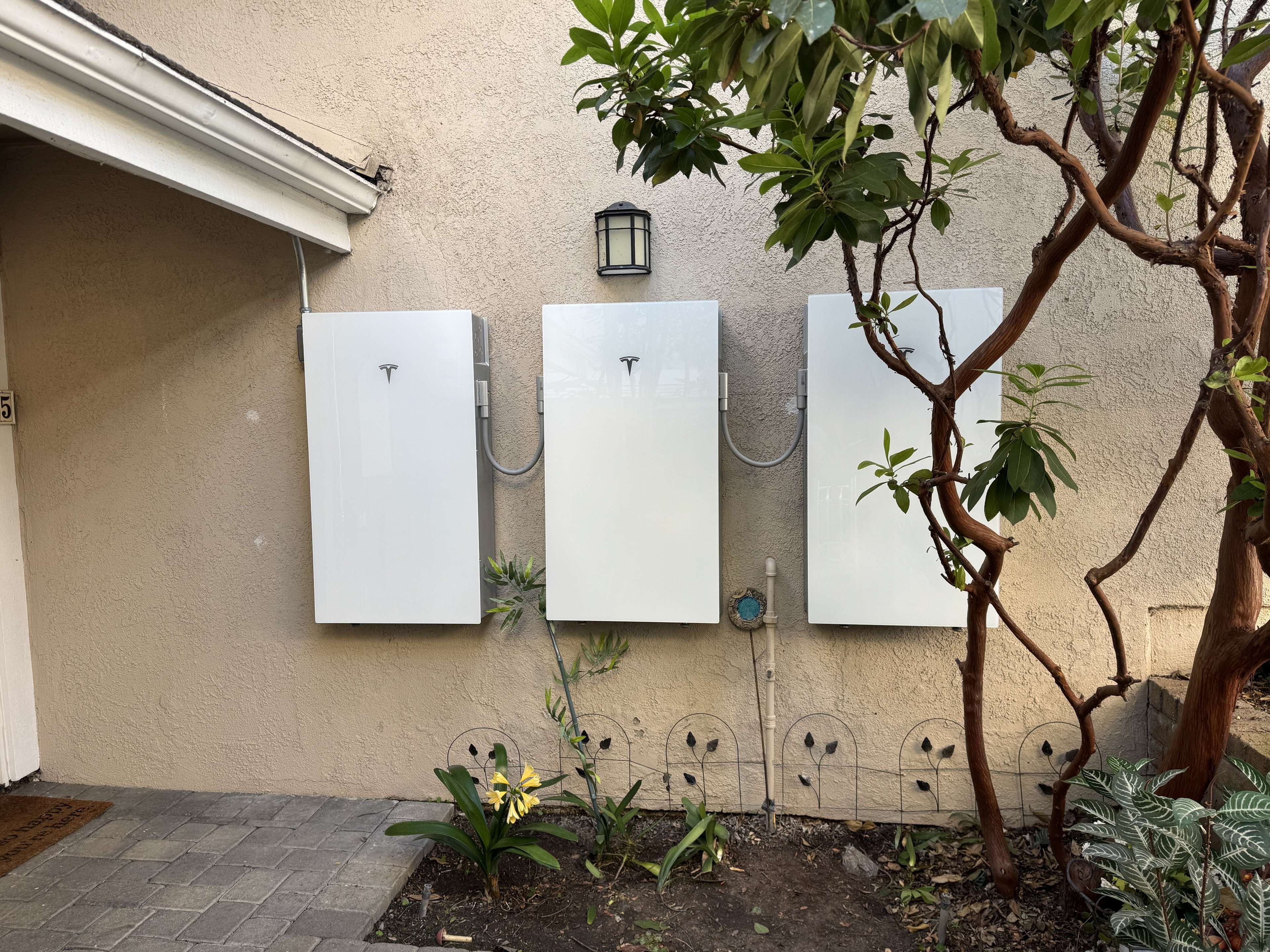
Quick answer
Where you live in Southern California decides whether a home battery pays for itself, because each utility prices evening power and solar exports differently.
- Biggest savings: SDG&E. Evening power costs up to 80¢/kWh, so one Powerwall 3 saves about $2,250 in year one and pays for itself in about 5 years. In San Diego Community Power areas, its $350/kWh rebate cuts that to about 3 years.
- Fastest payback: Burbank. With its $530/kWh rebate, one Powerwall 3 costs $4,045 and pays for itself in about 5 years. A grid-tied IQ Battery 10C pays back in about 4.
- SCE: no rebate, but the highest evening prices. One Powerwall 3 at $11,200 pays for itself in about 7 years and saves about $23,800 over 15 years.
- Riverside and Glendale: slower. About 10 years in Riverside and 12–13 in Glendale for one Powerwall 3.
- Backup first: Pasadena and LADWP. Solar there still earns close to retail credit, so a battery barely changes the bill. Buy it for outages.
Prices use EL-FI's 2026 pricing with a 30% discount: Powerwall 3 at $16,000 ($11,200 after the discount), and the IQ Battery 10C at $11,000 grid-tied ($7,700) or $15,000 with backup ($10,500). A second battery costs the same as the first; batteries three and four add $7,500 each for Powerwall 3 and $6,500 each for the IQ Battery 10C. These are estimates. Your final cost depends on site conditions and is set after a site visit from EL-FI Homes. We counted battery wear from Tesla's and Enphase's written warranty minimums and electricity prices rising 4% a year. Those two roughly cancel out, so yearly savings stay about flat. How much power you use from 4–9 p.m. will change your numbers.
How a battery saves you money, in 30 seconds
- At midday, your solar makes more power than your home uses. Normally that extra power goes to the grid for a small credit. On SCE that's about 3–10¢ per kWh.
- A battery stores it instead. You lose about 10% to charging and discharging.
- In the evening, the battery powers your home. You skip buying grid power when it's most expensive: 45–61¢ per kWh on SCE from 4–9 p.m.
- The difference is your savings. On SCE that's about 28–50¢ for every kWh the battery shifts, every day.
The bigger that gap in your city, the faster a battery pays off. The table below shows the gap for each utility.
Try it with your own numbers
The fastest way to get your answer is our battery payback calculator. Pick from a few menus and it shows your cost after rebates, yearly savings, payback year and return:
- Your utility: SCE, SDG&E (with or without San Diego Community Power), Burbank, Glendale, Riverside, Pasadena or LADWP.
- Your battery: Tesla Powerwall 3, Enphase IQ Battery 10C, or IQ Battery 10C with outage backup.
- One battery or two.
- Charged from solar or from the grid.
- How fast electric rates rise, from 0% to 8% a year.
- How much power you use from 4 to 9 p.m.
An EL-FI Homes advisor can review your bill, roof and panel and confirm your real price and savings. Contact the team to discuss your results. The sections below walk through the same choices with examples and full tables.
Choice 1: how many batteries?
A second battery doubles the cost. It only doubles the savings if your home actually uses that much power in the evening. One Powerwall 3 covers about 10.6 kWh of 4–9 p.m. use in year one (13.5 kWh minus the 20% kept for backup). Two cover about 21 kWh.
Here's how two Powerwall 3s on SCE ($22,400) do at different levels of evening use:
| Your 4–9 p.m. use | Year-1 savings | Pays for itself | 15-year return |
|---|---|---|---|
| 8 kWh a day | $1,149 | year 14.5 | +5% |
| 11 kWh a day | $1,580 | year 11.2 | +44% |
| 15 kWh a day | $2,154 | year 8.6 | +88% |
| 22 kWh a day | $3,056 | year 7.0 | +113% |
For comparison, one Powerwall 3 pays for itself in year 7.0 in every home using 11 kWh or more, and in year 8.2 at 8 kWh. Rule of thumb: buy a second battery for backup or a big evening load (a heat pump, an EV charging after 4 p.m., a pool pump), not for savings alone. With the IQ 10C with backup, the second battery pays back a little faster than the first, because both share the same backup equipment.
Three or four batteries
Larger all-electric homes, and homes that want most of the house backed up, sometimes ask for three or four batteries. From the third battery on, EL-FI's estimated price per battery drops: each additional Powerwall 3 adds $7,500, and each additional Enphase IQ Battery 10C adds $6,500. The same rule applies: extra batteries only add savings if your home uses the power in the evening.
| On SCE | Estimated price | Home uses 30 kWh from 4–9 p.m. | Home uses 45 kWh from 4–9 p.m. |
|---|---|---|---|
| 3 Powerwall 3 | $29,900 | $4,308 a year · pays back in year 6.4 | $4,583 a year · year 6.3 |
| 4 Powerwall 3 | $37,400 | $4,308 a year · year 7.4 | $6,111 a year · year 5.9 |
| 3 IQ 10C with backup | $24,700 | $3,395 a year · year 7.0 | $3,395 a year · year 7.0 |
| 4 IQ 10C with backup | $31,200 | $4,308 a year · year 6.7 | $4,527 a year · year 6.6 |
A fourth Powerwall 3 pays back faster than three only in a home that uses about 45 kWh in the evening. In a 30 kWh home, the fourth battery is mostly extra backup. On SDG&E, three Powerwall 3s pay back in about 4.4 years at 30 kWh of evening use.
Every price in this article is an estimate. Your final cost depends on your home's site conditions, such as the electrical panel, wall space, wiring runs and permits. EL-FI Homes confirms it after a site visit.
Choice 2: charge from solar or from the grid?
A battery saves the most when it stores midday solar that would otherwise earn a small export credit. Without solar, it charges from the grid overnight at the cheapest rate and runs the house in the evening. That works only where night power costs much less than evening power.
| Utility | 1 Powerwall 3 charged from solar | 1 Powerwall 3, no solar (charged from the grid) |
|---|---|---|
| SDG&E | $2,253 a year · pays back in year 4.9 | $739 a year · year 14.8 (TOU-DR1) |
| SCE | $1,528 a year · year 7.0 | $809 a year · year 13.5 |
| Burbank | $757 a year · year 5.3 (after rebate) | No savings. The rebate needs solar, and the standard rate has no evening peak. |
| Riverside | $429 a year · year 10.1 | $153 a year · doesn't pay back in 15 years |
| Glendale | $872 a year · year 12.5 | About the same as with solar |
| Pasadena, LADWP | Little or no bill savings | Little or no bill savings |
So for savings, a battery belongs with solar. A grid-charged battery still makes sense for outage backup, and on SCE it still earns a modest return.
Choice 3: Powerwall 3 or Enphase IQ Battery 10C?
Enphase batteries can't be installed on their own. The IQ Battery 10C works only as part of an Enphase solar system (IQ8 microinverters and Enphase controls). If you have no solar, or your solar uses another brand's inverter, the Powerwall 3 is the battery to look at. It has its own built-in inverter and works with or without solar.
| Tesla Powerwall 3 | Enphase IQ Battery 10C | Enphase IQ Battery 10C + backup | |
|---|---|---|---|
| Storage | 13.5 kWh | 10 kWh | 10 kWh |
| Works without solar | Yes | No, needs Enphase solar | No, needs Enphase solar |
| Powers the home in an outage | Yes | No | Yes |
| EL-FI price after 30% off | $11,200 | $7,700 | $10,500 |
| Warranty | 10 years, 70% capacity | 15 years, 60% capacity | 15 years, 60% capacity |
| Payback on SCE (1 battery) | year 7.0 | year 6.5 | year 8.8 |
The grid-tied 10C pays back fastest because it skips the backup equipment, but it shuts off with the grid during an outage. If backup is the reason you want a battery, compare the Powerwall 3 with the 10C + backup.
Tesla Powerwall 3 specifications
From Tesla's Powerwall 3 datasheet and warranty:
| Specification | Powerwall 3 |
|---|---|
| Energy storage | 13.5 kWh |
| Continuous power | 11.5 kW per unit |
| Motor starting | 185 LRA (helps start AC compressors and pumps) |
| Built-in solar inverter | Up to 20 kW of solar, 6 MPPTs |
| Efficiency | 97.5% solar to home; 89% solar to battery to home |
| How many per home | Up to 4 Powerwall 3 units |
| Backup switchover | Automatic, through Tesla's Gateway |
| Size and weight | 43.25 × 24 × 7.6 in, 287 lb |
| Where it can go | Indoors or outdoors, floor or wall mount; NEMA 3R enclosure, IP67 battery and electronics |
| Operating temperature | –4°F to 122°F (output may be reduced above 104°F) |
| Safety certifications | UL 1741, UL 9540, UL 9540A, UL 3741 |
| Warranty | 10 years, 70% capacity at year 10, unlimited cycles for solar self-consumption or time-based control with backup |
Our model uses 90% efficiency for both batteries. Using Tesla's 89% changes yearly savings by less than $15.
Rebates and rates by utility
A battery saves money when the evening power it replaces costs much more than the midday solar you store. The "value per kWh" column is that gap, after a 10% round-trip loss.
| Utility | Battery rebate (2026) | Evening price you avoid | Midday solar is worth | Value per kWh shifted |
|---|---|---|---|---|
| SCE | None for most homes | 45¢ winter, 61¢ summer weekdays (TOU-D-PRIME, 4–9 p.m.) | 7–10¢ export credit incl. bonus (SCE) | 28–50¢ |
| SDG&E | None for most homes. The state SGIP rebate is closed except an equity waitlist. | 80¢ summer, 52¢ winter (EV-TOU-5, 4–9 p.m. every day) | About 5–6¢ export credit (our estimate, locked 9 years) | 47–74¢ |
| SDG&E with San Diego Community Power | $350/kWh with new solar, $250/kWh added to existing solar ($500 / $350 for CARE, FERA or Communities of Concern), plus 10¢ per kWh discharged on weekday evenings | Same as SDG&E | Same as SDG&E | 47–74¢ |
| Burbank (BWP) | $530/kWh (no federal credit), first 100 kWh; must have solar and discharge 80% daily 4–7 p.m. | 27.82¢ (tier 2) (BWP) | 6.96–8.25¢ export credit (BWP) | 19–20¢ |
| Glendale (GWP) | No official rebate found | 46.76¢ winter, 56.10¢ summer (L-1-B TOU peak, weekdays) | 15.59–18.70¢ (net metering at off-peak retail) | 29–35¢ weekdays |
| Riverside (RPU) | $500/kWh, up to $10,000; must be on D-TOU | 17.28¢ winter, about 19¢ summer (D-TOU) | 5.97–6.47¢ export credit | 11–12¢ |
| Pasadena (PWP) | $350/kWh ($550 income-qualified); 36 months in a utility VPP | about 33¢ (TOU on-peak, all-in) (PWP) | 25–27¢ (net metering at off-peak retail) | 3–5¢ weekdays |
| LADWP | Income-qualified SGIP only | 27–30¢ (R-1B) | Same price (full retail net metering) | About 0¢ |
| Anaheim (APU) | $1,500 per home (from July 1, 2026); TOU + MyPower Savings | Peak price not published online | Wholesale-based export credit | Not modeled |
Anaheim isn't in the results because its current on-peak TOU price isn't posted. Call APU for your rate before deciding.
What one Powerwall 3 costs vs. what it saves
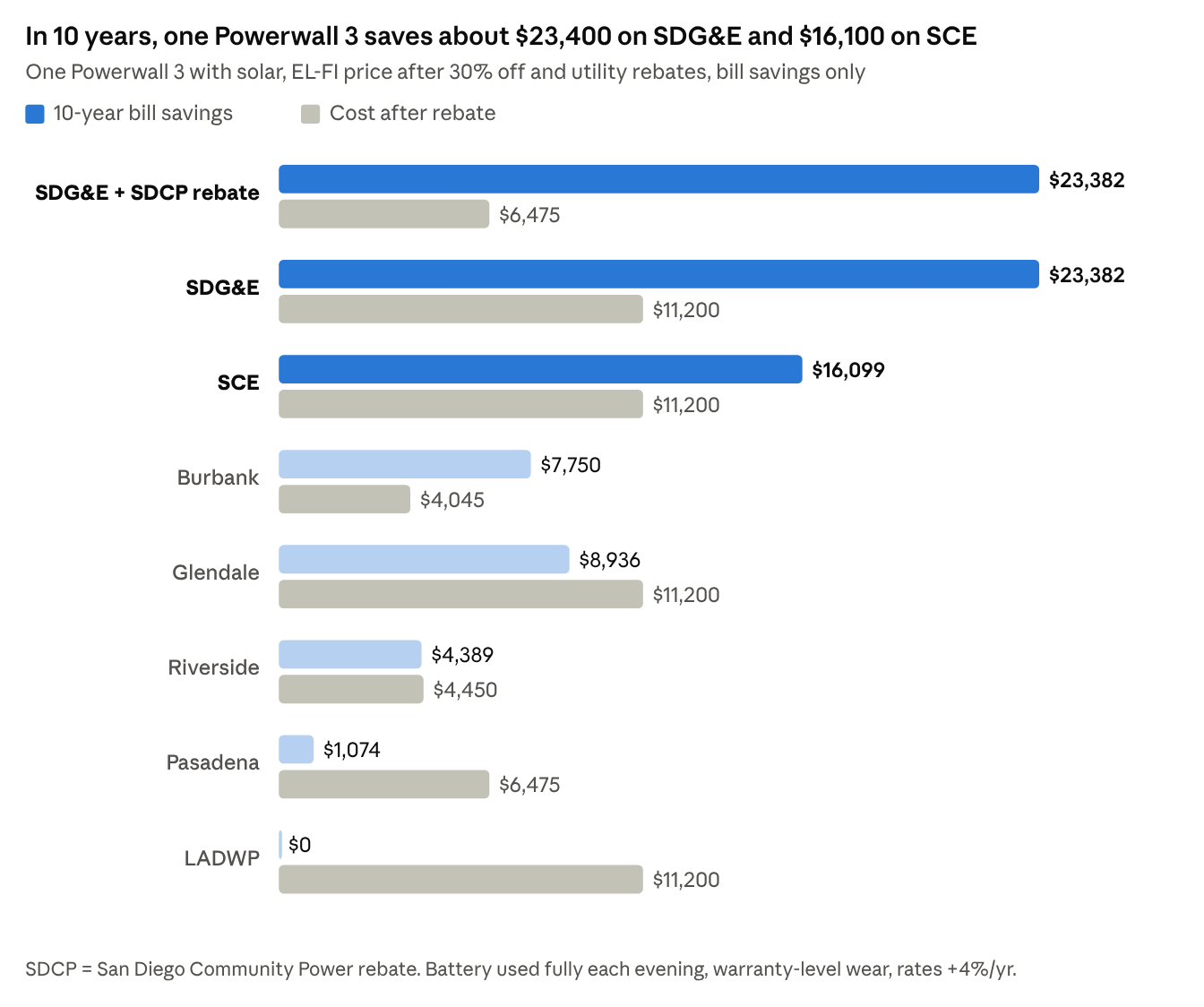
EL-FI Homes model, Nov 2026 · utility rates and rebates listed above · EL-FI price after 30% off
Over its 10-year warranty, one $11,200 Powerwall 3 saves about $23,400 on SDG&E and about $16,100 on SCE, more than its cost in both. In San Diego Community Power areas, the $350/kWh rebate drops the cost to $6,475 for the same savings. In Burbank it saves about $7,750 on a $4,045 cost after the rebate. In Pasadena and LADWP the bill savings are small, so the battery's value there is backup power.
Two things change every year: battery wear and electricity prices
The numbers above are for year one. Over time, two forces pull in opposite directions: the battery slowly holds less energy, and the power it replaces gets more expensive.
Battery wear. Every battery loses some capacity as it ages, like a phone battery. We used the minimum each manufacturer guarantees in writing:
- Tesla Powerwall 3: at least 70% of its 13.5 kWh after 10 years. Cycles are unlimited when the battery is used for solar, time-of-use savings or backup (Tesla warranty).
- Enphase IQ Battery 10C: at least 70% after 10 years and 60% at the end of 15 years or 6,000 cycles, whichever comes first (Enphase warranty). Emptying the battery once a day uses about 365 cycles a year, so 15 years comes first.
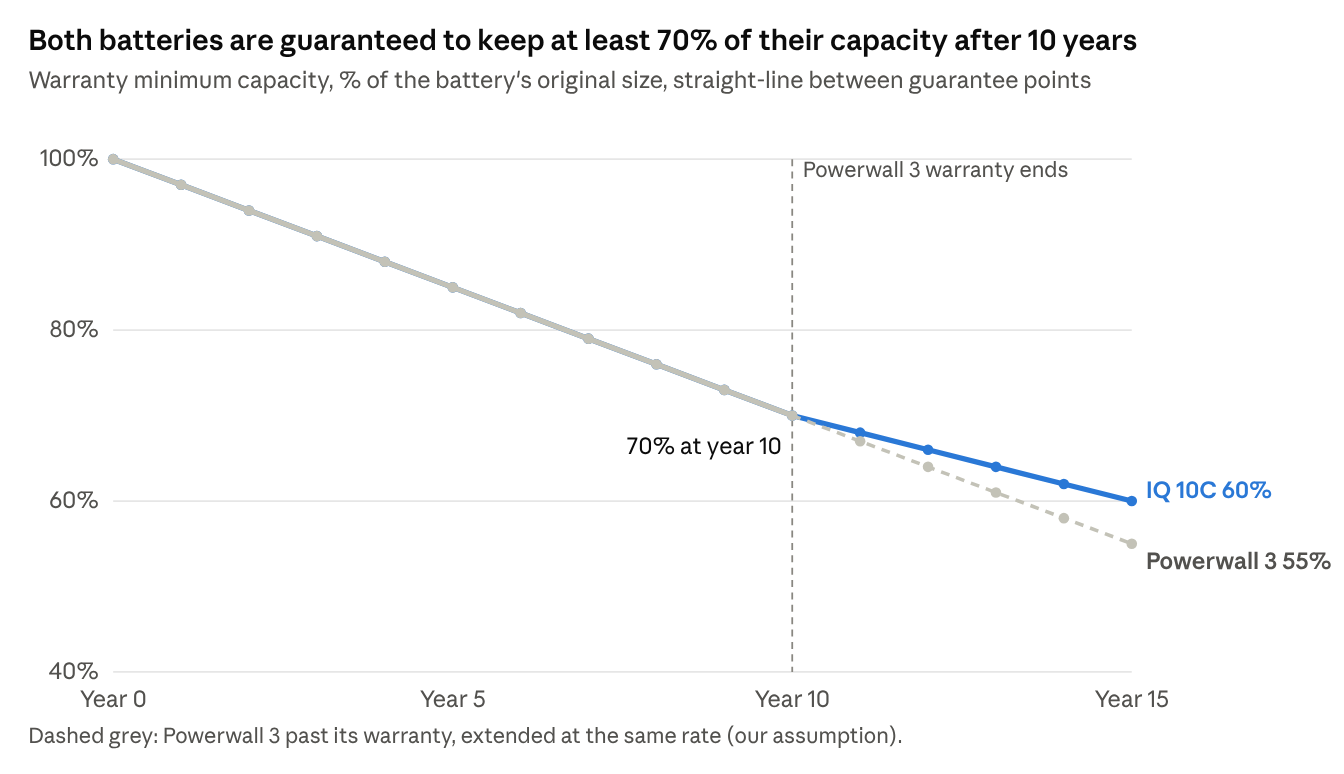
Tesla Powerwall Limited Warranty (USA) Rev. 2.6; Enphase IQ Battery 10C Limited Warranty LGL-00047 v2.0
Real batteries often do better than the warranty minimum, so this is a cautious view.
Rising electricity prices. SCE's average home rate rose about 69% over the last 10 years, or about 5.2% a year (Public Advocates Office, Q2 2026). In September 2025 the CPUC approved SCE base revenue rising from $9.66 billion in 2025 to $11.18 billion in 2028, about 5% a year (CPUC fact sheet). Base revenue is only part of the bill, so rates don't rise one-for-one with it. We use 4% a year as the middle case, and show 0% to 8% below.
One detail helps SCE customers: new solar customers' export credits are locked for nine years (SCE). So while evening prices rise, the credit you give up by storing solar stays flat, and each stored kWh is worth a little more every year. After year nine we assume export credits catch up with retail prices.
How long a battery lasts: cycles and throughput
Two numbers describe a battery's working life:
- Cycles: one cycle is one full charge and discharge. A battery that charges from solar each day and covers your evening use runs about 365 cycles a year.
- Throughput: the total energy a battery delivers over its life, in megawatt-hours (MWh). 1 MWh is 1,000 kWh.
How much energy one battery delivers to your home in our model, after keeping 20% in reserve and losing capacity at the warranty rate:
| One battery, used daily | Year 1 | First 10 years | 15 years | Cycles in 15 years |
|---|---|---|---|---|
| Powerwall 3 | 3.9 MWh | 33.5 MWh | 45.8 MWh | about 5,500 |
| IQ Battery 10C | 2.9 MWh | 24.8 MWh | 34.3 MWh | about 5,500 |
What this means for you:
- Daily use fits inside both warranties. About 5,500 cycles in 15 years is under Enphase's 6,000. Over its 10-year warranty, a Powerwall 3 used daily delivers about 33.5 MWh, under the 37.8 MWh cap that applies to other uses.
- Grid programs add cycles. If you join a virtual power plant, ask how those extra discharges count toward your warranty before you enroll.
- A battery doesn't stop at the end of its warranty. It keeps working with less capacity. Our 15-year Powerwall 3 numbers assume it keeps losing 3% a year after year 10, which makes them conservative.
- Each delivered kWh replaces evening grid power. That's the source of your savings, and the reason lifetime throughput matters more than the size printed on the box.
The payback picture, year by year
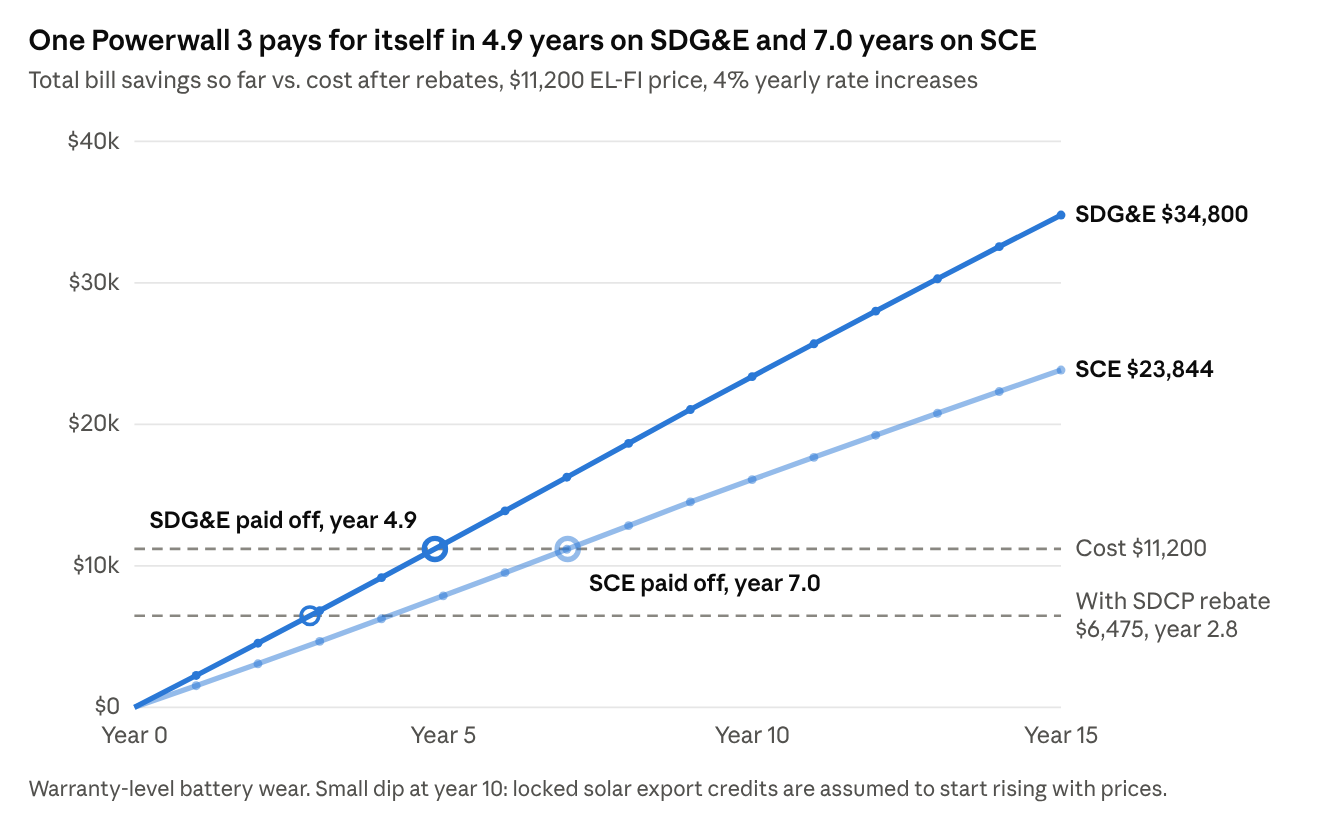
EL-FI Homes model, Nov 2026 · 1 Powerwall 3, EL-FI price after 30% off, SDG&E EV-TOU-5 and SCE TOU-D-PRIME, 4% yearly rate increases
Each year the battery holds a little less, but each kWh it shifts is worth a little more, so yearly savings stay roughly flat: about $2,250–$2,400 on SDG&E and about $1,500–$1,680 on SCE. Where a savings line crosses a dashed cost line, the battery has paid for itself; everything above it is money ahead. With San Diego Community Power's rebate, an SDG&E customer gets there in under 3 years.
Levelized cost and return on investment, in plain terms
Three numbers tell you whether a battery is a good investment. At EL-FI's pricing, one Powerwall 3 or a grid-tied IQ 10C scores well on all three on SDG&E and SCE, and in Burbank, and comes out ahead in Riverside.
- Levelized cost of storage (LCOS): what the battery costs you for each kWh it delivers over its life. Think of it as your "price per kWh" for battery power. We discount future kWh at 5% a year, the standard way to compare money today with money later.
- Return on investment (ROI): total savings minus what you paid, as a share of what you paid. +82% means you get your money back plus 82% more.
- Internal rate of return (IRR): the yearly interest rate the battery "pays" you. Compare it with what that money would earn elsewhere.
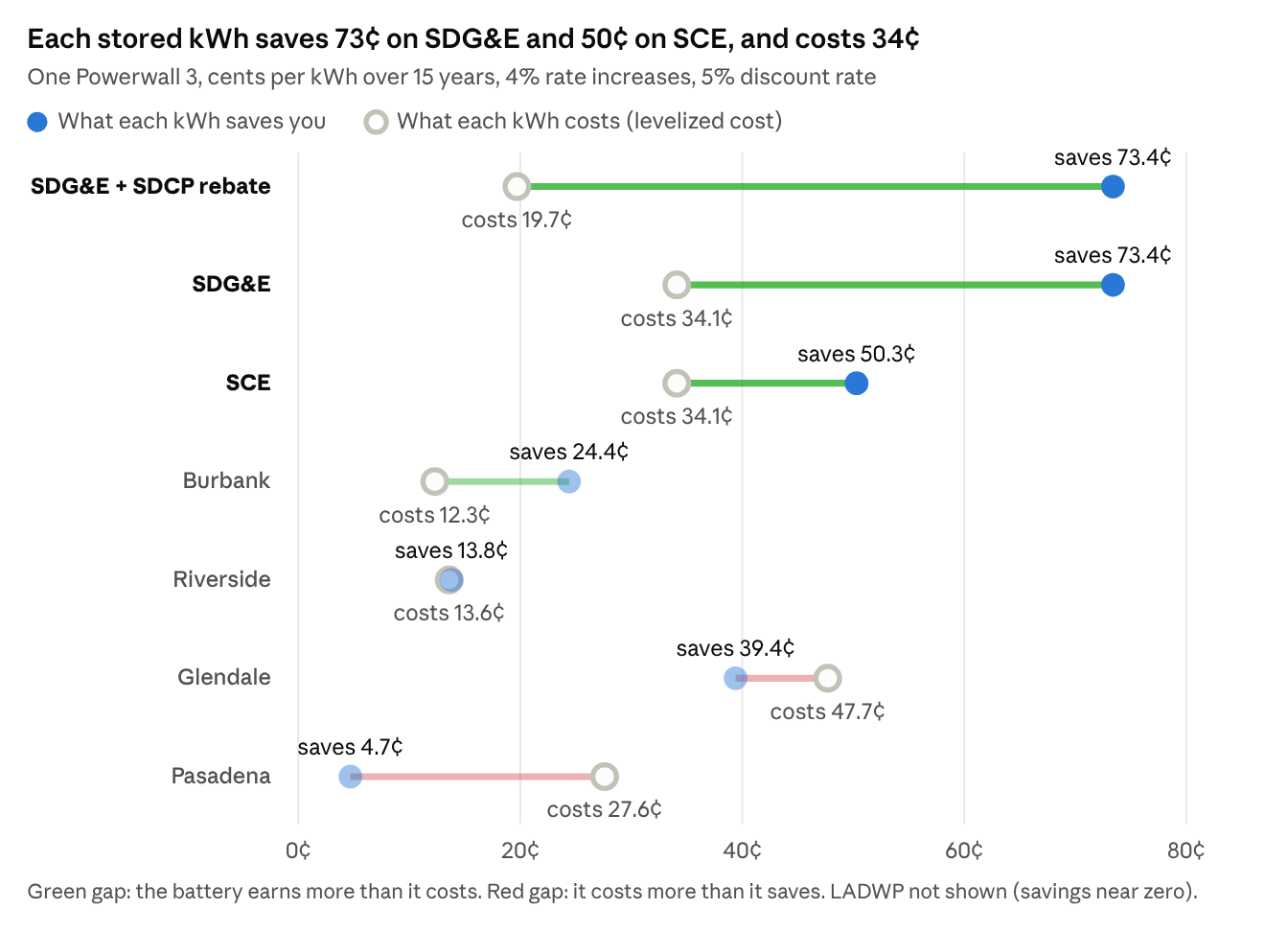
EL-FI Homes model, Nov 2026 · 1 Powerwall 3 · levelized at a 5% discount rate · SDCP = San Diego Community Power rebate
These returns count bill savings only. Backup power during outages and grid program payments come on top, and they are the main reason to buy a battery in Pasadena, Riverside and LADWP.
What if rates rise slower or faster?
Faster-rising rates help most in the later years, so they raise the 15-year return more than they shorten the payback.
In the calculator you can drag the rate slider anywhere from 0% to 8% a year. Here is what that does for one Powerwall 3 on SDG&E and SCE:
| Rates rise each year | SDG&E: pays for itself · saved in 15 years | SCE: pays for itself · saved in 15 years |
|---|---|---|
| 0% (prices never go up) | year 5.3 · $26,590 | year 8.2 · $18,031 |
| 2% | year 5.1 · $30,363 | year 7.5 · $20,706 |
| 4% (our middle case) | year 4.9 · $34,800 | year 7.0 · $23,842 |
| 6% | year 4.7 · $40,025 | year 6.6 · $27,524 |
| 8% | year 4.5 · $46,184 | year 6.2 · $31,853 |
Even if prices never rose, one Powerwall 3 would still pay for itself on both SDG&E and SCE. Faster increases mostly raise what you save in the later years.
Full numbers: what you pay and what you get back over 15 years
With 4% yearly rate increases and warranty-level battery wear, one Powerwall 3 on SCE saves about $23,800 over 15 years on an $11,200 system. It pays for itself in about 7 years.
Step 1: what the battery costs you after rebates (one battery / two batteries)
| Utility | Powerwall 3 | IQ 10C grid-tied (no backup) | IQ 10C with backup |
|---|---|---|---|
| EL-FI price after 30% off | $11,200 / $22,400 | $7,700 / $15,400 | $10,500 / $18,200 |
| Burbank (−$530/kWh) | $4,045 / $8,090 | $2,400 / $4,800 | $5,200 / $7,600 |
| SDG&E + San Diego Community Power (−$350/kWh) | $6,475 / $12,950 | $4,200 / $8,400 | $7,000 / $11,200 |
| Riverside (−$500/kWh, max $10,000) | $4,450 / $12,400 | $2,700 / $5,400 | $5,500 / $8,200 |
| Pasadena (−$350/kWh) | $6,475 / $12,950 | $4,200 / $8,400 | $7,000 / $11,200 |
| SCE, Glendale, LADWP (no rebate) | $11,200 / $22,400 | $7,700 / $15,400 | $10,500 / $18,200 |
Step 2: total bill savings over 15 years, and the year it pays for itself (one / two)
| Utility | Powerwall 3 | IQ 10C grid-tied | IQ 10C with backup |
|---|---|---|---|
| SCE | $23,842 · yr 7.0 / $47,684 · yr 7.0 | $17,898 · yr 6.5 / $35,797 · yr 6.5 | $17,898 · yr 8.8 / $35,797 · yr 7.7 |
| SDG&E | $34,800 · yr 4.9 / $69,601 · yr 4.9 | $26,128 · yr 4.5 / $52,256 · yr 4.5 | $26,128 · yr 6.1 / $52,256 · yr 5.3 |
| SDG&E + SD Community Power | $34,800 · yr 2.8 / $69,601 · yr 2.8 | $26,128 · yr 2.5 / $52,256 · yr 2.5 | $26,128 · yr 4.1 / $52,256 · yr 3.3 |
| Burbank | $11,584 · yr 5.3 / $23,168 · yr 5.3 | $8,699 · yr 4.2 / $17,397 · yr 4.2 | $8,699 · yr 9.1 / $17,397 · yr 6.7 |
| Riverside | $6,561 · yr 10.1 / $13,122 · yr 14.2 | $4,926 · yr 8.3 / $9,853 · yr 8.3 | $4,926 · none / $9,853 · yr 12.6 |
| Glendale | $13,358 · yr 12.5 / $26,715 · yr 12.5 | $10,030 · yr 11.6 / $20,060 · yr 11.6 | $10,030 · none / $20,060 · yr 13.7 |
| Pasadena | $1,606 / $3,212 · none | $1,206 / $2,412 · none | $1,206 / $2,412 · none |
| LADWP | $0 | $0 | $0 |
How to read it: compare a cell in Step 2 with the same cell in Step 1. If savings are bigger than cost, the battery pays for itself; the year shows when. "None" means not within 15 years.
Three patterns stand out:
- Two of the same battery pay back in the same year as one. Each battery costs the same and saves the same, so you double both. The exception is the IQ 10C with backup, where the $4,000 backup equipment is shared, so the second battery pays back faster.
- The grid-tied IQ 10C pays back fastest, but it doesn't keep your lights on in an outage. The Powerwall 3 and the 10C with backup do.
- Riverside's rebate is capped at $10,000, so a second Powerwall 3 there gets no extra rebate.
The Powerwall 3's years 11–15 run past its 10-year warranty, so they assume it keeps working. Over just the 10-year warranty, one Powerwall 3 on SCE saves $16,099.
15-year return (ROI · IRR), 4% yearly rate increases
| Utility | 1 Powerwall 3 | 1 IQ 10C grid-tied | 1 IQ 10C with backup | 2 IQ 10C with backup |
|---|---|---|---|---|
| SCE | +113% · 11.4%/yr | +132% · 12.9%/yr | +70% · 7.5%/yr | +97% · 9.9%/yr |
| SDG&E | +211% · 19.2%/yr | +239% · 21.1%/yr | +149% · 14.2%/yr | +187% · 17.2%/yr |
| SDG&E + SD Community Power | +437% · 35.2%/yr | +522% · 40.4%/yr | +273% · 23.5%/yr | +367% · 30.0%/yr |
| Burbank | +186% · 17.3%/yr | +262% · 22.7%/yr | +67% · 7.2%/yr | +129% · 12.6%/yr |
| Riverside | +47% · 5.3%/yr | +82% · 8.6%/yr | −10% · −1.3%/yr | +20% · 2.4%/yr |
| Glendale | +19% · 2.3%/yr | +30% · 3.5%/yr | −4% · −0.6%/yr | +10% · 1.2%/yr |
| Pasadena | −75% | −71% | −83% | −78% |
| LADWP | −100% | −100% | −100% | −100% |
Two Powerwall 3s or two grid-tied 10Cs earn the same return as one, except in Riverside, where the rebate cap drops two Powerwall 3s to +6%.
Over just 10 years (the Powerwall 3 warranty): on SCE, one Powerwall 3 returns +44% (7.1%/yr), a grid-tied 10C +55% and a 10C with backup +14%. In Burbank, +92%, +139% and +10%.
What we assumed, and what changes the numbers
| Assumption | Value | Source |
|---|---|---|
| Powerwall 3 | 13.5 kWh, 11.5 kW continuous, up to 4 per home | Tesla Powerwall 3 datasheet |
| IQ Battery 10C | 10.0 kWh usable, 90% AC round-trip, 15-yr warranty | Enphase datasheet |
| Round-trip efficiency | 90% for both | Tesla rates Powerwall 3 at 89% solar-to-battery-to-home; using 89% changes yearly savings by under $15 |
| Backup reserve | 20% kept for outages | — |
| Daily use | Battery empties into the home's evening use every day it saves money | — |
| Capacity fade | Warranty minimums: Powerwall 3 down 3%/yr to 70% at year 10; IQ 10C 70% at year 10, 60% at year 15 | Tesla and Enphase warranties |
| Installed price, 1 battery | EL-FI pricing less 30%: Powerwall 3 $11,200; IQ 10C $7,700 grid-tied, $10,500 with backup | EL-FI Homes pricing (estimates; final cost set after a site visit) |
| Second battery | Same price as the first. Batteries 3 and 4: +$7,500 each (Powerwall 3) or +$6,500 each (IQ 10C). Final price set after an EL-FI site visit; the 10C's $4,000 backup add-on ($2,800 after discount) counted once | EL-FI |
| Federal tax credit | None (ended for purchases after 2025) | IRS |
| Electricity prices | Rise 4% a year (also tested 2.7% and 5.2%); SCE export credits locked 9 years | — |
| SDG&E | With solar: EV-TOU-5, 80.2¢ summer / 52.4¢ winter evenings, midday exports about 5–6¢ (estimate), locked 9 years. No solar: TOU-DR1, 69.1¢ / 61.5¢ evenings vs 37.4¢ / 43.7¢ overnight. Summer June–October. | SDG&E total rates tables, Aug 1, 2026 |
| Grid charging (no solar) | Charges at the cheapest overnight price: SCE 24–26¢, Riverside 12.5¢, SDG&E TOU-DR1 super off-peak. Enphase batteries can't be grid-only; Burbank's rebate needs solar. | Utility tariffs |
What moves the result most:
- Your evening use. Two Powerwall 3s shift about 21.6 kWh a day. That only pays off in a home that uses that much between 4 and 9 p.m. (central AC, EV charging, a pool pump). In a smaller home, the second battery mostly adds backup.
- Your price. Every $1,000 off the installed price shortens SCE payback for one Powerwall 3 by about 8 months.
- Your rate tier and plan. Burbank savings assume your evening imports fall in tier 2 (27.82¢); in tier 1 (18.00¢) they drop by about half. Glendale assumes you're on L-1-B TOU with net metering still open to you.
- Pasadena's TOU hours. PWP doesn't publish its residential peak hours online; we assumed weekday peaks.
- When you got solar. SCE customers who went solar before April 2023 (NEM 2.0) and LADWP, Pasadena and Glendale net-metering customers get much less from storing solar than new SCE solar customers do.
- Grid payments. SCE customers can add VPP income (about $100–$250 a year, per Enphase); Pasadena requires 36 months in its VPP; Anaheim pays up to $100 a year through MyPower Savings. None are counted above.
About the author
Researched and reviewed by Uday Singh, EL-FI Homes. Uday is a Master of Science student at Arizona State University, holds an MBA from UCLA Anderson, and previously worked in product management. EL-FI Homes (CSLB #1113934; C10, C20, C46) installs Tesla and Enphase battery systems across Los Angeles, Orange, Riverside and San Bernardino counties.
Rebates, rates and prices change often. Figures reflect published information as of November 3, 2026. Your EL-FI proposal uses your own bills and pricing.
References
- SCE — TOU-D-PRIME rate plan
- SCE — Solar Billing Plan export credit values
- Burbank Water and Power — Battery Storage Program and rebate application v02.06.26
- Burbank Water and Power — Electric rates (Jan 1, 2026) and Solar Net Billing export values
- Pasadena Water and Power — Residential Battery Storage Rebate Program
- Pasadena Water and Power — Winter rate card, Oct 1, 2026 and summer rate card, 2026
- Glendale Water & Power — Residential electric rates
- Riverside Public Utilities — Energy Storage Rebate Program, D-TOU schedule and export values July 2026
- LADWP — Residential rates and SGIP
- Anaheim Public Utilities — Battery Storage rebate
- Enphase — IQ Battery 10C datasheet
- SDG&E — EV-TOU-5 total rates, Aug 1, 2026 and TOU-DR1 total rates, Aug 1, 2026
- SDG&E — Time-of-use hours (When Matters) and Solar Billing Plan export pricing
- Self-Generation Incentive Program — program metrics, budget status by utility
- San Diego Community Power — Solar Battery Savings program
- Tesla — Powerwall warranty (USA) and Powerwall 3 datasheet
- California Public Utilities Commission — SCE 2025 General Rate Case fact sheet (Sept 18, 2025)
Disclaimer. Rebates and incentives change from time to time. Programs can end, change their rules or run out of funding without notice, and utility rates change during the year. Check the current program with your utility before you decide. Savings shown here are estimates based on published rates, not guarantees. All prices are estimates: your final cost depends on your home's site conditions and is confirmed after a site visit from EL-FI Homes.