


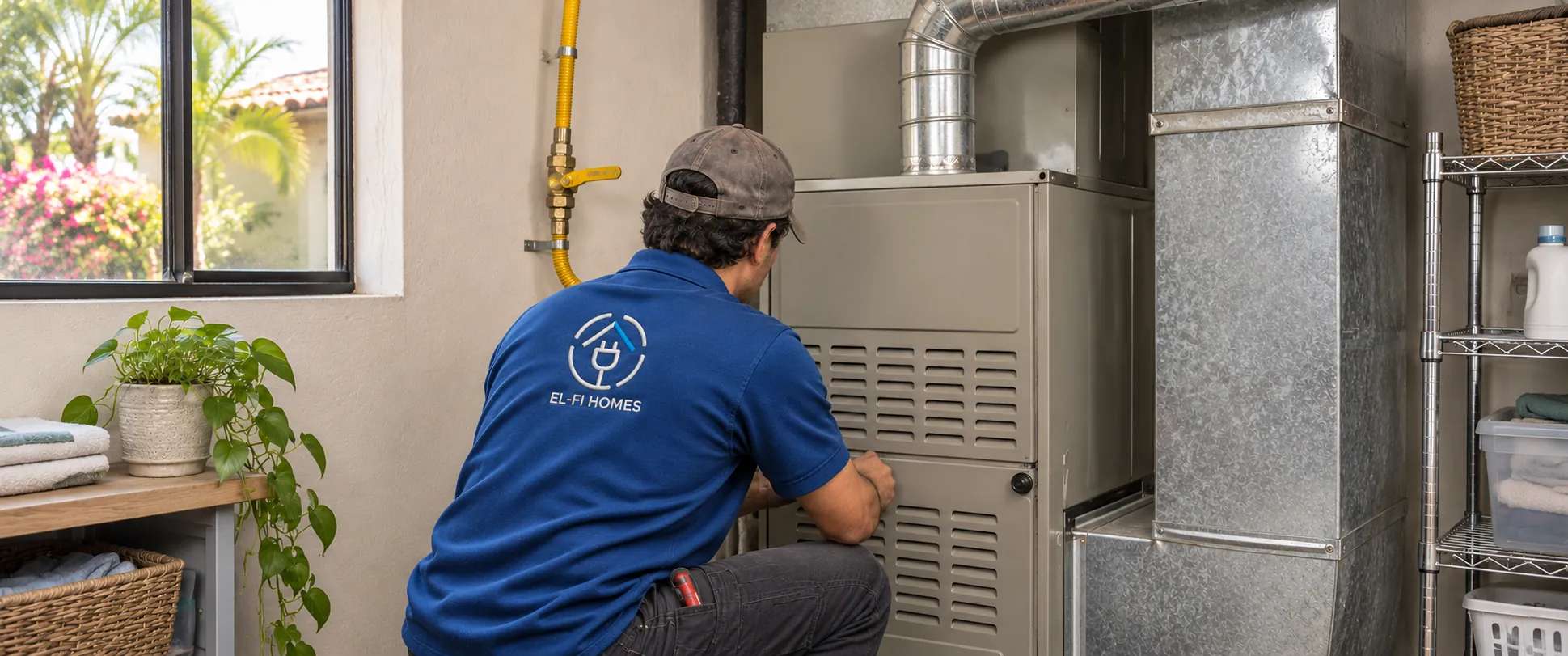
EL-FI Homes installs gas furnaces, but our policy is to stand behind electrification. For most Southern California homes we recommend a heat pump first: one system heats and cools, it burns nothing inside the home, and it can run on your solar.
Some homeowners still want a furnace, and some homes are not ready for a heat pump yet. When a furnace is the right call for you, we will install it properly and tell you plainly how it compares. This guide explains the furnace types we offer so you can choose with the full picture.
To compare the two on cost, read our article Heat Pump vs. Gas Furnace in Southern California.
Quick answer
Most homes here are better served by a heat pump; if you want a gas furnace, the right type depends on your vent, how even you want the heat, and your budget.
| If you want | Choose | Models to ask about |
|---|---|---|
| The simplest like-for-like replacement at the lowest price | 80%, single-stage, multi-speed blower | AC Pro 80% single-stage, Daikin DR80SN-U, Goodman GR9S80-U |
| Even, quiet heat while keeping your existing flue | 80%, two-stage, variable-speed blower | AC Pro A802VX |
| Lower gas use | 95 to 97%, single-stage | AC Pro 95% single-stage, Daikin DR96SN-U or DR96SC-U, Goodman GR9S96-U or GRVS96-U |
| The most comfortable and efficient gas furnace we can install | 97%, two-stage, variable-speed blower | AC Pro A972VX |
| Heating and cooling in one system with no combustion in the home | A heat pump | Our first recommendation |
Every furnace named here is an ultra-low NOx model, which South Coast AQMD has required since October 2019.
Know the furnace you have
How your furnace vents and how it lights tell you which kind it is. The U.S. Department of Energy sorts gas furnaces into three groups (DOE Energy Saver).
| What you see | What you have | Efficiency (AFUE) |
|---|---|---|
| A pilot light that burns all the time, and a wide metal flue | An old, low-efficiency furnace | 56% to 70% |
| A metal flue pipe, no pilot light, and a small fan that starts before the burners light | A standard, mid-efficiency furnace | 80% to 83% |
| White plastic vent pipes and a small drain line | A high-efficiency, condensing furnace | 90% to 98.5% |
The efficiency number is the share of the gas you pay for that reaches your rooms as heat. The rest goes up the flue. An old furnace with a pilot light is the most expensive kind to run.
The label inside the furnace's front panel lists the model number and the input in BTU per hour. That input is a good starting size for the calculator, which asks which of these three furnaces you have.
Three choices define every furnace
Every gas furnace is described by three choices: how much of the gas becomes heat, how the burner adjusts, and how the blower moves air. A model name such as "97% two-stage variable" is simply those three answers in order.
| Choice | Options you will see | What it changes for you |
|---|---|---|
| Efficiency (AFUE) | 80%, 95 to 96%, 97% and up | Gas use, how the furnace is vented, whether it needs a drain |
| Burner (gas valve) | Single-stage, two-stage, modulating | Room-to-room comfort, temperature swings, sound |
| Blower motor | Multi-speed ECM, variable-speed ECM | Airflow, sound, fan electricity, how well it pairs with your AC |
AFUE (annual fuel utilization efficiency) is the share of the gas you pay for that ends up as heat in the house over a season. An 80% furnace sends about 20 cents of every gas dollar up the flue; a 97% furnace sends about 3 cents.
Efficiency: 80%, 95 to 96%, or 97%
The efficiency tier changes the installation more than it changes comfort. An 80% furnace sends hot exhaust up a metal flue. A 95%+ furnace adds a second heat exchanger that pulls so much heat out of the exhaust that water condenses, so it needs different vent piping and a drain.
| Tier | How it works | What the install needs | Fits best when |
|---|---|---|---|
| 80% AFUE (non-condensing) | One heat exchanger; exhaust leaves hot | The existing vertical metal flue; no drain | You are replacing like for like, or a new vent route and drain are impractical |
| 95 to 96% AFUE (condensing) | A secondary heat exchanger recovers heat from the exhaust | Sealed intake and exhaust pipes (one-pipe or two-pipe) and a condensate drain | The vent and drain can be routed cleanly and you heat the home regularly |
| 97% AFUE and up (condensing) | Same condensing design with slightly more heat recovered | Same as 95 to 96% | You want the lowest gas use; AC Pro's 97% model also adds two-stage heat |
For the same heat delivered, a 95 to 97% furnace burns about 16 to 18% less gas than an 80% furnace (80 ÷ 95 = 0.84; 80 ÷ 97 = 0.82). In coastal Southern California, where furnaces run few hours a year, that saving is real but small in dollars, so the venting and drain work often decides the choice.
The U.S. Department of Energy defines AFUE as a furnace's annual heat output divided by the fossil fuel energy it consumes (DOE Energy Saver). For the same heat, gas use falls in step: where an 80% furnace burns 100 therms, a 96% furnace burns 83 and a 97% furnace burns 82.
Each therm not burned avoids 11.7 lb of carbon dioxide, from the EPA factor of 0.0053 metric tons per therm (EPA). Nitrogen oxides do not change with efficiency here: every furnace sold in the district is capped at 14 nanograms per joule of heat delivered (South Coast AQMD Rule 1111).
Sources for the install differences: AC Pro's 80% two-stage spec sheet (must be vented vertically) and 97% two-stage spec sheet (secondary heat exchanger; certified for two-pipe direct vent or one-pipe venting).
Burner: single-stage, two-stage, or modulating
The burner type decides how steady the heat feels. This is the "variable burner" choice: the more finely the flame can be turned down, the longer and gentler each heating cycle runs.
| Burner | How it runs | What you notice at home |
|---|---|---|
| Single-stage | Full fire or off | Lowest price and simplest parts; short, strong bursts of heat and wider temperature swings |
| Two-stage | A reduced low fire most of the time, high fire on the coldest mornings | Longer, quieter cycles and more even temperatures between rooms |
| Modulating | Adjusts the flame in small steps across a wide range | The steadiest temperature and quietest operation; the highest price |
Two-stage matters more here than the mild climate suggests. A furnace is often sized around the airflow the air conditioner needs, so on a typical winter day it has more heat than the house calls for. A low-fire stage matches that small load better than a burner that only knows full fire.
A variable burner is a comfort feature more than a gas saver. Lawrence Berkeley National Laboratory, a U.S. Department of Energy lab, compared two-stage and single-stage furnaces at the same efficiency rating and concluded that two-stage technology by itself does not save energy. Depending on the test method, fuel use ranged from 3.4% lower to 1.4% higher (LBNL-59865).
The environmental gain is at the fan. Staged heat lets the blower run slower, and the Department of Energy's fan analysis credits that with a further cut in fan electricity, from 41% to 46% below a fixed-speed motor.
Blower motor: fixed-speed, multi-speed or variable-speed
The blower motor decides how quietly and evenly air moves, in winter and in summer. This is the "variable motor" choice, and it matters year-round because the same blower pushes air across your air conditioner or heat pump coil.
| Blower | How it runs | What you notice at home |
|---|---|---|
| Fixed-speed (PSC) | One speed for heating and one for cooling, set by the wiring | The highest fan electricity and the most abrupt starts. Federal fan standards since July 3, 2019 are set at the ECM level, so you find this motor in older furnaces |
| Multi-speed ECM (AC Pro calls it "non-variable" or constant torque; Daikin and Goodman call it multi-speed or nine-speed) | An efficient motor set to one of several fixed speeds at installation | Solid efficiency and a lower price; airflow steps on and off |
| Variable-speed ECM | Ramps up and down continuously to hold the airflow the system asks for | Softer starts and stops, less fan noise, steadier airflow, better humidity control with the AC |
The two choices are sold together more often than apart. Across the three brands we reviewed, every two-stage ultra-low NOx furnace comes with a variable-speed blower, while single-stage furnaces are offered with either motor.
The Department of Energy's furnace fan standard, in force since July 3, 2019, measures fan energy against the older fixed-speed motor. Its analysis puts a multi-speed (constant-torque) ECM about 41% below that baseline, 46% with staged heat, and a variable-speed (constant-airflow) ECM with staged heat about 51% below (DOE final rule, 2014, Table IV.9).
In Southern California the kilowatt-hours involved are small. The average Southern California Edison home's furnace fan uses about 101 kWh a year (California Energy Commission), and California grid power emits 428.5 lb of carbon dioxide per megawatt-hour (EPA eGRID). Berkeley Lab also found that the savings shrink in mild climates such as Los Angeles and in restrictive ducts (LBNL). Choose variable speed for quiet, even airflow first.
The lineup we can install here
Twelve ultra-low NOx furnaces across AC Pro, Daikin and Goodman cover every legal combination we found. Only AC Pro offers a two-stage burner in ultra-low NOx form; every Daikin and Goodman ultra-low NOx model is single-stage, so within those brands the choice is the blower motor.
| Brand | Model | AFUE | Burner | Blower | Notes |
|---|---|---|---|---|---|
| AC Pro | 80% single-stage "non-variable" | 80% | Single-stage | Constant-torque ECM (to confirm) | Entry model; spec sheet not posted online |
| AC Pro | A802VX | 80% | Two-stage | Variable-speed ECM | 60,000 to 100,000 BTU/h; works with a communicating thermostat |
| AC Pro | 95% single-stage "non-variable" | 95% | Single-stage | Constant-torque ECM (to confirm) | Condensing; spec sheet not posted online |
| AC Pro | A972VX | 97% | Two-stage | Variable-speed ECM | 40,000 to 80,000 BTU/h; natural gas only |
| Daikin | DR80SN-U | 80% | Single-stage | Multi-speed ECM | Daikin's entry ultra-low NOx model |
| Daikin | DR80SC-U | 80% | Single-stage | Variable-speed ECM | Works with Daikin One+ communicating controls |
| Daikin | DR96SN-U | Up to 97% | Single-stage | Nine-speed ECM | 40,000 to 80,000 BTU/h; 97.0% on the spec sheet |
| Daikin | DR96SC-U | Up to 96% | Single-stage | Variable-speed ECM | Communicating |
| Goodman | GR9S80-U | 80% | Single-stage | Multi-speed ECM | Sold in California only |
| Goodman | GRVS80-U | 80% | Single-stage | Variable-speed ECM | ComfortBridge communicating; sold in California only |
| Goodman | GR9S96-U | Up to 96% | Single-stage | Multi-speed ECM | ENERGY STAR certified |
| Goodman | GRVS96-U | Up to 96% | Single-stage | Variable-speed ECM | ComfortBridge communicating; ENERGY STAR certified |
No brand here lists a modulating furnace in ultra-low NOx form. Daikin's two-stage DR96TC and modulating DR97MC are 40 ng/J models; the DR96TC spec sheet says it "can no longer be installed" in South Coast AQMD. Goodman marks only its single-stage -U models as ultra-low NOx.
Warranty terms differ by brand and by model, so confirm them for the model on your quote.
| Brand | Parts | Heat exchanger | Unit replacement |
|---|---|---|---|
| AC Pro | 10 years | Lifetime | None listed |
| Daikin | 12 years | 20 years or lifetime, by model | 6 years on DR80SC-U and DR96SN-U, with annual maintenance |
| Goodman | 10 years | 20 years | 5 years on GR9S96-U and GRVS96-U, with annual maintenance |
Daikin and Goodman ask for online registration within 60 days of installation, and AC Pro's heat exchanger coverage also depends on registration.
What a furnace costs installed
These are our installed price ranges for replacing a furnace in the same location, with the permit allowance, start-up and haul-away of the old furnace included. They are the same in every county we serve. Every furnace we price is an ultra-low NOx furnace.
| Furnace size (BTU per hour) | Installed price |
|---|---|
| 40,000 | $5,300 to $8,000 |
| 60,000 | $5,700 to $10,000 |
| 80,000 | $6,550 to $10,000 |
| 100,000 | $7,350 to $10,300 |
Where you land in the range depends on the furnace you choose. A standard 80% furnace sits toward the low end. A 96% high-efficiency furnace with a variable-speed blower sits toward the high end. We confirm the size your home needs and give you one exact price in a written quote.
Duct work, asbestos or lead abatement, electrical panel upgrades and major gas line changes are priced after we see the home.
The calculator shows the range for your size and what each furnace would save on your gas bill and in carbon.
Ultra-low NOx furnaces
Every furnace we install is an ultra-low NOx furnace. That is the standard South Coast AQMD sets for new gas furnaces here. It holds nitrogen oxides to 14 nanograms per joule of heat, down from 40 under the older limit (rule text).
Rebates
The larger local incentives now go to heat pumps, not gas furnaces. Our article Heat Pump vs. Gas Furnace in Southern California covers what a heat pump costs to run and where its incentives stand.
SoCalGas lists a rebate for furnaces rated 92% or higher (SoCalGas rebates). Programs open and close during the year, so we check what applies to your home when we quote.
Furnace, heat pump, or both
A heat pump is still our first recommendation, and anyone buying a furnace should see this comparison before deciding.
| Gas furnace + AC | Heat pump | Dual fuel (heat pump + gas furnace) | |
|---|---|---|---|
| Heats with | A gas burner | Electricity, moving heat in from outdoor air | The heat pump first, the furnace as backup |
| Cools with | A separate air conditioner | The same unit | The same heat pump |
| Burns fuel in the home | Yes: gas line, flue and NOx limits apply | No | Only when the furnace runs |
| Runs on your solar | The blower only | Heating and cooling | Cooling and most heating |
| What we check first | Vent route, and a drain for 95%+ | Electrical panel capacity | Both |
A furnace still makes sense in a few situations: the furnace failed mid-winter and the air conditioner is nearly new, the electrical panel cannot take a heat pump without an upgrade you are not ready for, or you simply prefer gas heat. In those cases we install the furnace and leave the path to a heat pump open for the day the air conditioner is replaced.
For the running-cost comparison, with and without solar, read Heat Pump vs. Gas Furnace in Southern California.
How to choose
Three questions, in this order, settle the choice for most homes.
- Can a heat pump do the job? If your panel has the capacity and your air conditioner is due for replacement anyway, a heat pump is our recommendation and the rest of this list does not apply.
- Where will the exhaust go? If the furnace must reuse the existing metal flue, or a drain cannot be routed, choose 80%. If sealed vent pipes and a drain are practical, 95 to 97% is open to you.
- How even and quiet should the heat be? For the most even heat, choose two-stage with a variable-speed blower: AC Pro A802VX at 80% or A972VX at 97%. For quiet airflow on a simpler furnace, choose single-stage with a variable-speed blower: Daikin DR80SC-U or DR96SC-U, Goodman GRVS80-U or GRVS96-U. For the lowest price, choose single-stage with a multi-speed blower.
Product literature
These are the manufacturer documents this guide was built from. Open them to check a model's sizes, venting, blower and warranty for yourself.
AC Pro
Daikin
Where the numbers come from
Every factor in the calculator's gas bill and emissions comes from a government agency, a national laboratory, or the SoCalGas tariff that the California Public Utilities Commission approves.
| Input | What the calculator uses | Source |
|---|---|---|
| Furnace efficiency and gas use | Gas use = heat needed ÷ AFUE | U.S. Department of Energy, Energy Saver: Furnaces and Boilers |
| Heating gas for an average home | 128 therms a year in SoCalGas homes with gas heat. Average California home: 1,567 sq ft | California Energy Commission, 2019 Residential Appliance Saturation Study |
| Other gas appliances | Water heater 267, range or oven 26, clothes dryer 13 therms a year (SoCalGas homes) | California Energy Commission, 2019 study |
| Gas rates | Baseline $1.39117 and over baseline $1.86801 per therm. Customer charge $0.16438 a day. Effective November 10, 2026 | SoCalGas Schedule GR, tariff on file with the California Public Utilities Commission |
| Baseline allowance, therms a day | Summer 0.424 in every zone. Winter on-peak (December to February): 1.600, 1.867, 2.600 for Zones 1, 2, 3. Winter off-peak (November, March, April): 0.874, 0.923, 1.714 | SoCalGas Advice Letter 5778, effective May 1, 2021 |
| Winter climate by ZIP code | SoCalGas sets three baseline zones by heating degree days a year: Zone 1 up to 2,500, Zone 2 2,501 to 4,500, Zone 3 4,501 to 7,000. We place your ZIP code using California's 16 building climate zones | SoCalGas Preliminary Statement, Part I; California Energy Commission, building climate zones |
| Efficiency of the furnace you have | Old furnaces with a pilot light: 56% to 70%. Mid-efficiency: 80% to 83%. High-efficiency: 90% to 98.5% | U.S. Department of Energy, Energy Saver: Furnaces and Boilers |
| Carbon dioxide from gas | 0.0053 metric tons per therm, which is 11.7 lb | U.S. EPA, Greenhouse Gas Equivalencies Calculator |
| Nitrogen oxides | At most 14 nanograms per joule of useful heat for ultra-low NOx furnaces. The earlier limit was 40 | South Coast AQMD Rule 1111 |
| Burner staging and gas use | Two-stage against single-stage at the same efficiency: 3.4% less to 1.4% more fuel. The calculator assumes no difference | Lawrence Berkeley National Laboratory, LBNL-59865 (2006) |
| Fan electricity by motor | Below a fixed-speed motor: multi-speed ECM 41%, with staged heat 46%, variable-speed ECM with staged heat 51% | U.S. Department of Energy, furnace fan final rule (July 3, 2014), Table IV.9 |
| Fan electricity for an average home | 101 kWh a year in Southern California Edison homes | California Energy Commission, 2019 study |
| Fan savings in mild climates | Savings are small or negative in mild climates and restrictive ducts | Lawrence Berkeley National Laboratory, Furnace Blower Electricity (2008) |
| Carbon dioxide from electricity | 428.5 lb per megawatt-hour for California (CAMX) | U.S. EPA, eGRID2023 |
| Miles driven and trees | 0.000393 metric tons of CO2 equivalent per mile for an average gasoline car. 0.060 metric tons of CO2 for one urban tree seedling grown for 10 years | U.S. EPA, Greenhouse Gas Equivalencies Calculator |
| Heat pump efficiency | HSPF2 7.5, the federal minimum for split-system heat pumps since January 1, 2023. That is 7,500 BTU of heat per kilowatt-hour | U.S. Department of Energy, 2023 efficiency standards |
The steps that are ours
- We treat the average existing furnace as an 80% furnace, so the average home's heat need is 80% of the gas it burns. If you tell us your furnace is very old we count it at 63%, and at 94% if it is high-efficiency. Those are the midpoints of the Department of Energy's ranges.
- We scale heating gas and fan electricity by your floor area against the 1,567 sq ft average.
- Your ZIP code sets your winter climate. We place each ZIP code's town on the Energy Commission's climate zone map. High desert ZIP codes (building climate zone 14) are treated as SoCalGas Zone 2 and mountain ZIP codes (zone 16) as Zone 3. Everywhere else is Zone 1. This match is ours and it is approximate. Your SoCalGas bill shows your actual baseline zone, and we confirm it for your address.
- For Zones 2 and 3 we scale heating by SoCalGas's winter baseline allowances, which gives 1.19 and 2.13 times Zone 1. We spread heating across the six winter billing months the same way.
- If you enter your January gas bill, we run the SoCalGas rates backwards to get your January therms, take out the other gas appliances, and scale your heating to match.
- The 15-year totals multiply the first-year saving by 15 at today's gas rates. We do not assume gas prices rise, and we do not count furnace wear.
- The heat pump carbon figure delivers the same heat at the federal minimum efficiency, with electricity from the California grid and no solar.
- The gas bill covers SoCalGas gas charges and the customer charge. The public purpose surcharge, local taxes and the yearly climate credit are left out. If another gas utility serves your home, your rates will differ.
- Price ranges are EL-FI Homes installed prices for replacing a furnace in the same location, as of November 2026. The low end is a standard 80% furnace and the high end a 96% high-efficiency furnace.
To check the calculator against your own home, enter your January gas bill under "Match it to your own bill". For scale, SoCalGas describes its average residential customer as using 36 therms a month (notice filed with the CPUC).
Prices, rebates and rules are as of November 24, 2026 and can change.