


Quick answer
In Southern California, a modern heat pump costs roughly the same to heat your home as a new gas furnace. Whether it comes out a little cheaper or a little more expensive depends on your utility, your rate plan and what time of day the heat runs.
The bigger wins sit around the heating bill:
- One system instead of two. A heat pump replaces both your furnace and your air conditioner.
- Better cooling. A new heat pump cools more efficiently than an aging AC, and summer is when SoCal homes use the most energy.
- It pairs with solar. SCE's cheapest winter hours (8 a.m.–4 p.m.) are the same hours your solar panels produce.
On SCE's heat-pump-friendly TOU-D-PRIME plan, midday heat from a heat pump costs about $2.34 per therm of heat delivered, versus about $2.21 from a 95%-efficient gas furnace. Overnight heat costs about $2.93. Heat during the 4–9 p.m. window costs about $4.40. The full math and assumptions are below.
On SDG&E, both gas and electricity cost more. A new gas furnace delivers heat for about $2.88 a therm. On TOU-ELEC, SDG&E's plan for heat-pump homes, a heat pump's cheapest hours cost about $3.29 a therm and 4–9 p.m. about $4.94. Homes with an EV or on the Solar Billing Plan can use EV-TOU-5 instead, where heat during super off-peak hours costs about $1.20, less than half the price of gas.
Cooling tips the scale. A 17 SEER2 heat pump uses about 16% less electricity to cool than a new minimum-efficiency AC (14.3 SEER2) and about 44% less than an older 10 SEER unit. On grid power, it costs about $40–$145 a year less to run than a new gas furnace with a minimum AC, and about the same as a new 95% furnace paired with an equally efficient 17 SEER2 AC. With solar, the heat pump breaks even or comes out ahead on SCE and clearly comes out ahead on SDG&E.
What changed on SoCal bills in 2025–2026
Here's what changed on SoCal bills this year, and what each utility charges for heat this winter. The short version: gas got cheaper, SCE's per-kWh prices dropped with its new fixed charge, and SDG&E has a plan built for heat-pump homes.
SCE
- New fixed charge, lower per-kWh price. In November 2025, SCE added a fixed Base Services Charge to every residential bill. At the same time, the per-kWh price dropped by roughly 10% (SCE). Lower per-kWh prices favor appliances that run on electricity, like heat pumps.
- Bills still rose overall. SCE's October 2025 increase raised the average residential rate to 35.3¢ per kWh, before the climate credit (SCE rate advisory).
- TOU-D-PRIME winter prices. This is SCE's plan for homes with a heat pump, battery or EV. In winter (October–May) it charges 30¢ per kWh overnight, 24¢ from 8 a.m. to 4 p.m. and 45¢ from 4 to 9 p.m., plus a $0.79 daily charge (SCE).
SoCalGas
- Average gas rate. The average residential gas rate was about $2.10 per therm in March 2026, including delivery and the gas itself (SoCalGas).
- Gas is cheaper this month. The gas-commodity part of the rate for November 2026 is about 20% lower than a year ago (SoCalGas).
- Increases are requested, not approved. SoCalGas has asked regulators for a rate increase that would start in 2028; it has not been approved (SoCalGas notice).
LADWP
- Rates rose, but stay lower than SCE's. LADWP's January–March 2026 residential rates were about 2.5¢ per kWh higher than a year earlier. Tier 1 was about 24.8¢, before the city's 10% utility tax (LADWP residential rates).
SDG&E
- Gas. SDG&E's average residential gas rate was $2.74 per therm from January 1, 2026, up about 1.5% from October 2025 (SDG&E).
- TOU-ELEC, the plan for electrified homes. It's open to homes with a heat pump, a battery or an EV (SDG&E). Winter prices are 33.6¢ per kWh in super off-peak hours, 37.7¢ off-peak and 50.6¢ from 4 to 9 p.m., plus a $0.79 daily charge (SDG&E, Aug 2026).
- EV-TOU-5, for homes with an EV or on the Solar Billing Plan. Its winter super off-peak price is only 12.3¢ per kWh. Off-peak is 46.6¢ and 4–9 p.m. is 52.4¢ (SDG&E, Aug 2026).
- Super off-peak hours. Midnight to 6 a.m. and 10 a.m. to 2 p.m. on weekdays, and midnight to 2 p.m. on weekends (SDG&E).
How a heat pump heats, and why efficiency matters
A heat pump doesn't burn anything. It moves heat that already exists in the outdoor air into your home, using the same refrigerant loop an air conditioner uses, run in reverse. Moving heat takes far less energy than creating it, so a heat pump can deliver about 3 units of heat for every unit of electricity it uses. Even the best gas furnace tops out just under 1 unit of heat per unit of fuel (Carrier).
Three ratings tell you what you're buying:
- HSPF2 (heat pump heating). Heat delivered over a season divided by electricity used, measured in Btu per watt-hour. ENERGY STAR split systems need at least 7.8 HSPF2 (ENERGY STAR). Divide HSPF2 by 3.412 to get the average "units of heat per unit of electricity," called COP.
- SEER2 (cooling). The same idea for air conditioning. A higher number means lower summer bills. A new central AC sold in California must be at least 14.3 SEER2; this article compares a 17 SEER2 heat pump against that.
- AFUE (gas furnace). The share of the gas that becomes heat. Older furnaces are often around 80%; new condensing furnaces reach about 95%.
HSPF2 is measured in a test climate colder than coastal and inland Southern California. Our mild winters let heat pumps run closer to their best efficiency, so this article uses an average COP of 3.0. A home with leaky ducts or an undersized system will do worse; a well-installed variable-speed system can do better.
One more 2026 note: new heat pumps and ACs now use lower-impact refrigerants such as R-454B or R-32. Since 2025, the EPA has limited the refrigerants new home AC and heat pump equipment can use (EPA). Your existing system doesn't need to be replaced because of this rule.
The math: what a therm of heat costs
On SCE, heat from a heat pump costs about the same as a new gas furnace at midday. Overnight it costs about a third more, and 4–9 p.m. it costs about twice as much.
On SDG&E, a heat pump on TOU-ELEC costs about 15% more than a new gas furnace even in its cheapest hours, but less than an older 80% furnace. On EV-TOU-5, heat during super off-peak hours is the cheapest option in this article.
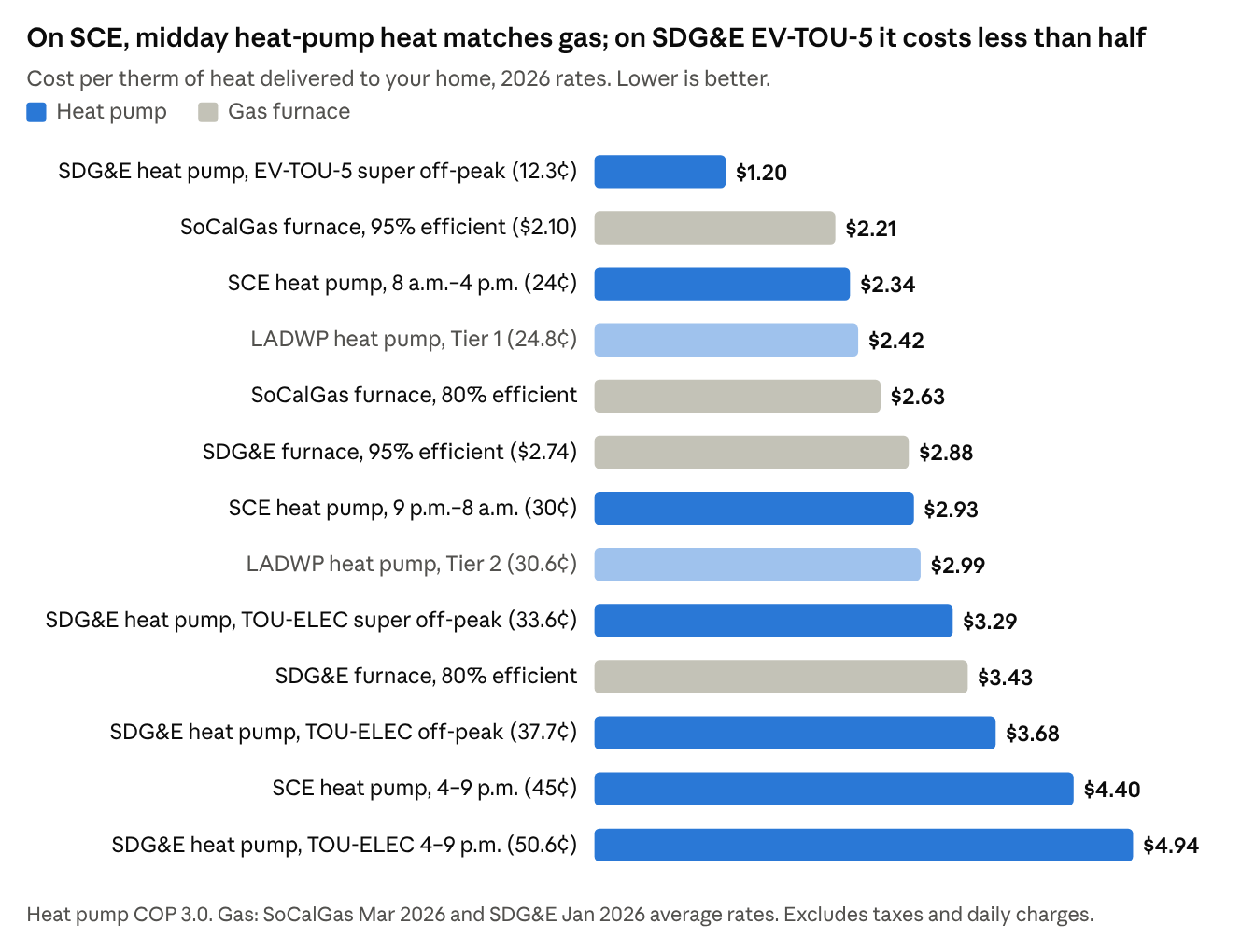
EL-FI Homes calculation from SCE TOU-D-PRIME winter 2026–27, SDG&E TOU-ELEC and EV-TOU-5 (Aug 2026), LADWP R-1A Jan–Mar 2026, SoCalGas March 2026 and SDG&E January 2026 gas rates
How we calculated it. A therm of heat equals 29.3 kWh. A heat pump with a COP of 3.0 needs about 9.8 kWh of electricity to deliver it. A gas furnace needs 1 therm of gas divided by its efficiency. We used the electricity price for each time window and SoCalGas's March 2026 average of $2.10 per therm. For San Diego we used SDG&E's January 2026 average of $2.74 per therm.
What it means for a whole winter. Take a home that needs 150 therms of heat over a winter (an illustrative figure; yours will differ):
- New gas furnace on SoCalGas: about $330.
- Heat pump on SCE: about $350–$440, depending on how much heating lands overnight versus midday.
- Heat pump on LADWP Tier 1: about $365.
- New gas furnace on SDG&E: about $430.
- Heat pump on SDG&E: about $495–$560 on TOU-ELEC, or about $180–$450 on EV-TOU-5, depending on how much heating lands in super off-peak hours.
- Heat pump powered by your own solar at midday: far less than any grid option.
The gap is a few hundred dollars a year at most, either way. That's why the cooling side, equipment cost and solar plan usually decide the choice, not the heating bill alone.
Cooling: what a 17 SEER2 heat pump saves
A gas furnace only heats, so a gas home also needs an air conditioner. A heat pump does both jobs. Its cooling efficiency is its SEER2 rating: Btu of cooling per watt-hour of electricity. A higher number means less electricity for the same comfort.
Take a home with a 3-ton system that runs the equivalent of 1,000 hours at full output each summer (an illustrative figure; coastal homes cool less, inland homes more):
| Cooling equipment | Rating | Electricity per summer | SCE | SDG&E |
|---|---|---|---|---|
| Heat pump (EL-FI comparison unit) | 17 SEER2 | about 2,120 kWh | about $795 | about $1,095 |
| New minimum-efficiency AC | 14.3 SEER2 | about 2,520 kWh | about $945 | about $1,300 |
| Older AC, about 10 SEER | about 9.5 SEER2 | about 3,790 kWh | about $1,420 | about $1,960 |
Dollar figures use the heat-pump plans for both options, so the table shows only the efficiency difference: SCE TOU-D-PRIME summer prices (about 37¢ a kWh blended) and SDG&E TOU-ELEC summer prices (about 52¢ blended), assuming 40% of cooling runs from 4 to 9 p.m. Minimum ratings are from the U.S. Department of Energy (DOE).
The whole year: heating plus cooling
The same home, needing 150 therms of heat in winter:
| Option (no solar) | SCE + SoCalGas | SDG&E |
|---|---|---|
| 17 SEER2 heat pump | about $1,145–$1,235 | about $1,590–$1,655 |
| New 95% gas furnace + 17 SEER2 AC | about $1,125 | about $1,530 |
| New 95% gas furnace + 14.3 SEER2 AC | about $1,275 | about $1,735 |
| Keep an older 80% furnace + 10 SEER AC | about $1,815 | about $2,475 |
On grid power alone:
- Against a new 95% furnace with an equally efficient 17 SEER2 AC, cooling costs the same and gas heat is slightly cheaper this winter. The furnace setup costs about $20–$125 a year less to run.
- Against a new furnace with a minimum 14.3 SEER2 AC, the heat pump saves about $40–$145 a year.
- Against an older furnace and AC, the heat pump saves about $580–$885 a year.
The heat pump ranges depend on how much heating lands in the cheapest hours. Solar changes the picture, below.
With solar: how the numbers change
With rooftop solar, a heat pump can warm the house during the day on your own power, then coast into the evening. That power isn't free: each solar kWh you use is one you don't send to the grid for an export credit. But that credit is small, so solar heat costs far less than grid heat.
Same home, 150 therms of heat a winter:
| Yearly heating cost | SCE + SoCalGas | SDG&E |
|---|---|---|
| New 95% gas furnace | about $330 | about $435 |
| Heat pump, no solar | about $350–$440 | about $495–$560 |
| Heat pump with solar (40–60% of heating at midday) | about $260–$340 | about $235–$380 |
Cooling is the same for a heat pump and a 17 SEER2 AC, and solar lowers it equally for both. So against a new 95% furnace with a 17 SEER2 AC, a heat pump with solar comes out about even to $70 a year ahead on SCE and about $55–$200 a year ahead on SDG&E. Against a furnace with a minimum AC or an older system, the heat pump's lead grows further.
How we figured it. Midday heating runs on your solar, valued at the export credit you give up: about 7¢ per kWh on SCE's Solar Billing Plan in winter (SCE) and 0–8¢ on SDG&E, pending SDG&E's 2026 export price file. The rest of the heating runs overnight and from 4 to 9 p.m. at TOU-D-PRIME and TOU-ELEC prices. The cost of the solar system itself isn't included. A battery can carry solar power into the evening and save more; see our home battery savings guide.
When a heat pump makes the most sense, and when it may not
The best time to switch is when your AC or furnace is near the end of its life. You're paying for new equipment either way, so the comparison becomes one heat pump versus a new furnace plus a new AC.
A heat pump usually makes sense when:
- Your AC is 12–15+ years old or needs a major repair, especially an R-410A refrigerant leak.
- You have solar, or plan to add it. Heat made from your own midday solar power costs far less than heat bought from the grid. Under California's current solar billing rules, power you send back to the grid earns little, so using it at home is worth more.
- You're an LADWP customer, where electricity is cheaper per kWh than SCE's.
- You can let the system warm the house during the day (8 a.m.–4 p.m. on SCE) and coast through the evening.
- You care about summer comfort. Cooling is most SoCal homes' biggest HVAC cost, and a new heat pump cools as efficiently as a new high-efficiency AC.
- You're on SDG&E and have an EV or solar, so you can heat during EV-TOU-5's super off-peak hours at about 12¢ per kWh.
It may not pay off yet when:
- Your furnace and AC are both fairly new and working well.
- You're on SCE without solar or a battery, and most of your heating happens 4–9 p.m.
- Your ductwork is leaky or undersized. Fix the ducts first; leaks waste money with either system.
- Your electrical panel is near capacity and the upgrade cost isn't in your budget yet.
- You're on SDG&E without solar or an EV. On TOU-ELEC, heat-pump heat costs a little more than heat from a new gas furnace.
Replacing your furnace and AC with one system
If you go with a heat pump, four things decide how well it performs and what it costs to run.
- Right-sized equipment. Your system should be sized to your home's actual heating and cooling load, not copied from the old unit's label. Oversized systems cycle on and off, waste energy and feel less comfortable. EL-FI installs AC Pro and Daikin equipment, and we'll match the efficiency level to your budget.
- Electrical capacity. Many homes can reuse the existing AC circuit. Others need a dedicated circuit or a main panel upgrade, especially if an EV charger or battery is coming. EL-FI holds C10 (electrical) and C20 (HVAC) licenses, so one crew handles both.
- The right rate plan. SCE customers with heat pump space heating qualify for TOU-D-PRIME (SCE). It has lower per-kWh prices but a higher daily charge and no baseline credit. Compare it against your current plan with SCE's rate comparison tool before switching.
- Solar and batteries. A heat pump turns rooftop solar into heating and cooling. A battery shifts that solar power into the 4–9 p.m. window, when grid power costs the most. If solar is on your list, plan both projects together so the solar system is sized for the new electric load.
FAQ
Will a heat pump keep my house warm on a cold SoCal night? Yes, if it's sized correctly. Southern California winter lows are mild by heat-pump standards. Many systems also include backup electric heat for rare cold snaps.
Is there still a federal tax credit for heat pumps? No. The federal 25C home-improvement credit doesn't apply to equipment placed in service after December 31, 2025 (IRS).
Are there California rebates? The statewide single-family HEEHRA rebates run through TECH Clean California are no longer taking new income verifications (The Switch Is On). Local utility and air-district programs change often. We check what's open for your address when we quote.
Can I keep my gas stove and water heater? Yes. A heat pump replaces only your furnace and air conditioner.
Do I need a new electrical panel? Not always. Many homes reuse the existing AC circuit. We check your panel during the site visit and tell you before any work starts.
Should I switch to SCE's TOU-D-PRIME plan? It often helps homes with a heat pump, battery or EV, because per-kWh prices are lower. It also has a higher daily charge and no baseline credit. Run SCE's rate comparison tool with your own usage first.
Which SDG&E plan is best for a heat pump? If you have an EV or are on the Solar Billing Plan, EV-TOU-5 usually is, because its super off-peak price is about 12¢ per kWh. Otherwise, TOU-ELEC is SDG&E's plan for homes with a heat pump, battery or EV. Both have a $0.79 daily charge. Try SDG&E's Pricing Plan Chooser with your own usage before switching.
About the author
Researched and reviewed by Uday Singh, EL-FI Homes. Uday is a Master of Science student at Arizona State University, holds an MBA from UCLA Anderson, and previously worked in product management. EL-FI Homes (CSLB #1113934; C10, C20, C46) designs and installs heat pumps, solar, batteries and electrical upgrades across Los Angeles, Orange, Riverside and San Bernardino counties.
Rates change often. Figures reflect published rates as of November 5, 2026. Check your own bill and rate plan before deciding.
References
- SCE — TOU-D-PRIME rate plan and eligibility
- SCE — Base Services Charge
- SCE — October 1, 2025 rate advisory
- SoCalGas — March 2026 rate alert
- SoCalGas — Current and historical gas procurement prices
- SoCalGas — General Rate Case notice
- LADWP — Residential electric rates, 2026
- ENERGY STAR — Air-source heat pump key product criteria
- Carrier — Heat pump efficiency
- IRS — FAQs on 25C and 25D terminations
- The Switch Is On — TECH Clean California status
- SDG&E — Natural gas rate alert, January 2026
- SDG&E — TOU-ELEC total rates, Aug 1, 2026 and EV-TOU-5 total rates, Aug 1, 2026
- SDG&E — Pricing Plan Chooser and time-of-use hours
- EPA — Technology Transitions final rule fact sheet
- U.S. Department of Energy — 2023 central AC and heat pump efficiency standards FAQ
- SCE — Solar Billing Plan