


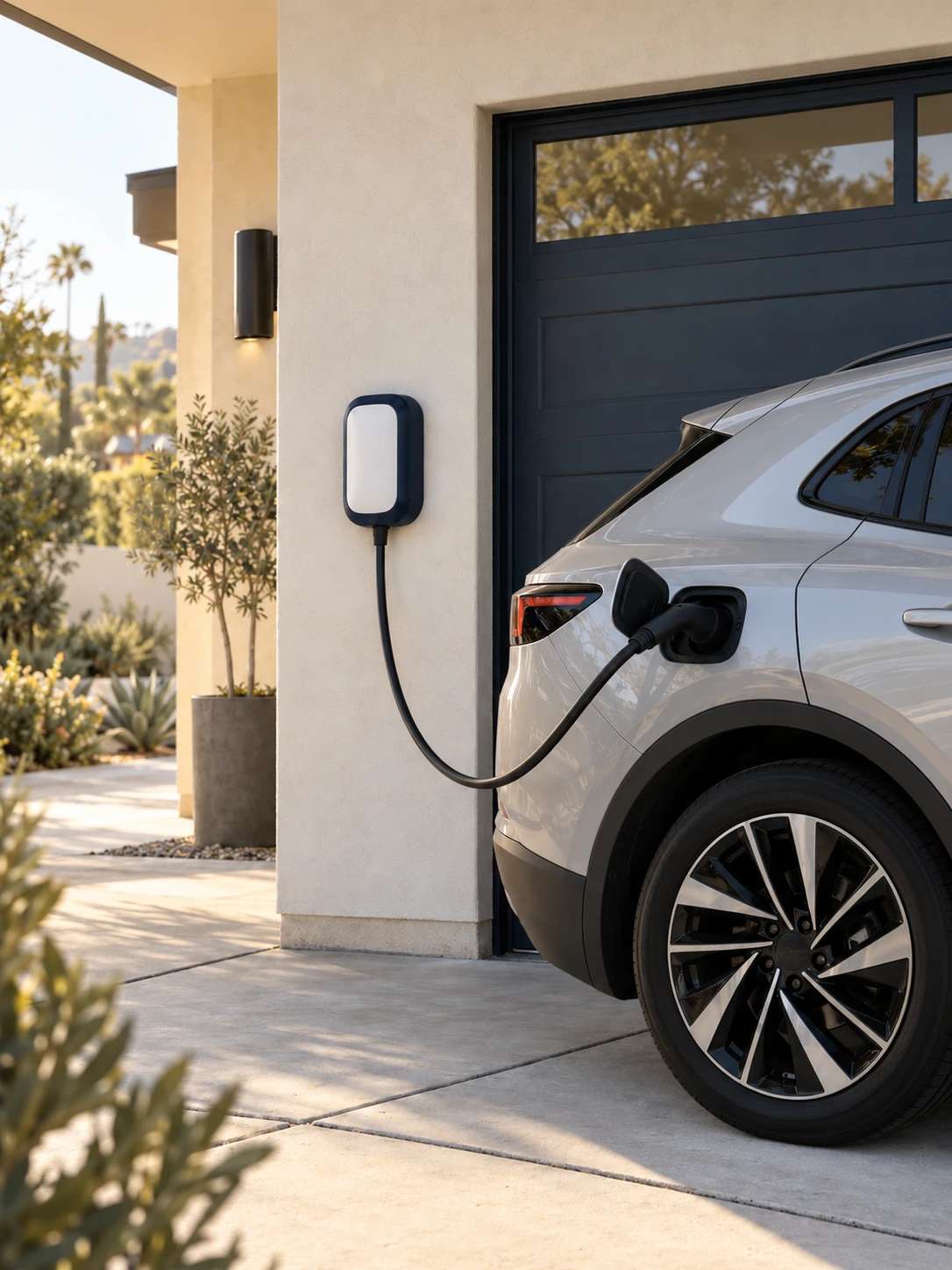
Start with your rate plan—not a universal “charge after 9 p.m.” rule.
Find your cheapest available hours, then compare direct solar charging with saving that solar energy for the home. A home battery can charge an EV, but using it is not automatically the least expensive option.
The same car. The same miles. A different bill.
Plugging in when you get home is convenient. On a time-of-use plan, it can also put a large new load into the most expensive hours. The simplest improvement may be scheduling the charger you already own.
But “overnight is cheapest” is no longer a reliable shortcut. SCE’s displayed winter TOU-D-PRIME price is lower from 8 a.m. to 4 p.m. than overnight. SDG&E also provides a weekday midday super-off-peak window on EV-TOU-5. [1] [2]
Which utility offers which charging rate?
These are selected residential plans, not every available option. All times below are local Southern California time. Prices are energy charges per kilowatt-hour (kWh); fixed charges and taxes are separate.
| Utility / plan | Lower-cost charging window | Energy prices and separate charges |
|---|---|---|
| SCE TOU-D-PRIME Source [1] | October–May: 8 a.m.–4 p.m. daily. June–September: outside 4–9 p.m. | Winter: 24¢ midday, 30¢ overnight, 45¢ from 4–9 p.m. Summer: 26¢ off-peak; 4–9 p.m. is 61¢ weekdays / 39¢ weekends. Displayed base charge: $0.79/day. These are SCE’s rounded customer-page prices. |
| SDG&E EV-TOU-5 [2] [3] | Weekdays: midnight–6 a.m. and 10 a.m.–2 p.m. Weekends / designated holidays: midnight–2 p.m. 4–9 p.m. is on-peak. | Summer: 13.090¢ super off-peak / 49.627¢ off-peak / 80.205¢ on-peak. Winter: 12.332¢ / 46.566¢ / 52.383¢ respectively. Standard base charge: $0.79343/day. Tariff effective Aug. 1, 2026. |
| LADWP R-1B time-of-use [4] [5] [6] | Base period: 8 p.m.–10 a.m. weekdays; all Saturday and Sunday. R-1A standard tiered service does not have an overnight time-of-use discount. | Oct.–Dec. 2026, calculated: 27.814¢ base period; 30.168¢ high / low peak. R-1B service charge: $12/month. Totals include published adjustment factors; taxes and any account-specific EV discount excluded. |
| Glendale Water & Power L-1-B time-of-use; L-1-E for eligible customer generation [7] [8] | July–October: base period outside 2–8 p.m. weekdays. November–June: base period outside noon–9 p.m. weekdays. Weekends and designated holidays are base period. | Price requires confirmation. The numeric rate is not included here. Check the billed rate plus applicable adjustments and charges with GWP. No Glendale dollar estimate is prefilled. |
LADWP calculation: Oct.–Dec. adjustment factors total $0.20150/kWh. Add the R-1B base-period energy component of $0.07664 to obtain $0.27814/kWh; add $0.10018 for high/low peak to obtain $0.30168/kWh. This is EL-FI’s arithmetic using the published components, not a separate utility quote. [5] [6]
See what changing your charging hours could save
This calculator compares the same amount of electricity at two prices. It measures energy entering your charger, not energy stored in the car. Use charging-station records when available.
A useful distinction: in the same SCE winter example, moving overnight charging at 30¢ to daytime at 24¢ saves $18 for 300 kWh, not $63. The larger result assumes you were charging during 4–9 p.m. Your starting schedule matters.
Compare the whole household before switching plans. A cheaper EV rate can come with higher prices when the air conditioner, oven and other appliances run. A bill review should compare a full year where possible, including plan fees, seasons and solar credits.
Can a home battery charge your EV?
Yes, if the electrical design and equipment support it. Tesla, for example, documents Powerwall supplying stored solar energy to an EV through the home electrical panel. That does not mean every charger is included in every backup installation. Confirm the charger circuit, battery power limit and other household loads. [9]
When direct charging can make sense
The car is home during low-priced grid hours or while there is surplus solar. Charging directly avoids routing that energy through a home battery first.
When stored energy may help
The car must charge during expensive hours, stored energy is available, and using it will not compromise your home’s reserve or a more valuable use later.
Stored energy has a cost—even when it came from solar
For an existing solar system, compare the export credit you would give up with the grid purchase you avoid. Also compare charging the car with using that energy to offset the home’s higher-priced evening demand. Solar used at home has an opportunity cost; a new solar installation also has equipment and financing costs.
For grid-charged storage, include conversion losses and battery wear. Here is an intentionally simplified example—not a measured battery specification:
At a direct-grid price of 13¢/kWh, this stored energy costs more before battery wear or equipment cost. At 45¢/kWh, it may reduce that session’s energy charge, but the complete comparison must include alternative uses, reserve and cycling cost. EV charging losses occur after the charger input boundary and are additional to this home-storage example.
Protect the home’s backup reserve
A car can request more energy than you want to take from the home battery. In a hypothetical system with 10 kWh available above reserve, you cannot deliver a 30 kWh charging session entirely from that stored energy. Solar or grid energy would need to supply the difference, and other home loads share the available capacity.
Our suggested order is to meet essential driving needs, preserve the household reserve, then choose the lowest-cost remaining source. During an outage, confirm backup operation with the installer instead of assuming the EV charger will stay energized.
Compatible control systems can coordinate this. Tesla’s Smart Charging, for example, uses a departure time, a charging target and supported equipment to plan charging around rates and solar. Compatibility and configuration matter. [10]
A practical charging plan in four steps
- Read the exact rate name. Record the utility, generation provider and whether the home has a solar tariff.
- Choose the available low-cost window. A cheap midday window helps only if the car is plugged in then.
- Check that the charging target fits. For example, 20 kWh at an assumed steady 7 kW charger input takes about 2.9 hours. Actual charging power and time vary.
- Review the result after a billing cycle. Compare charger energy, charging times and electricity charges. Separate changes in driving, weather and other home usage.
Let EL-FI review your charging plan at no cost
We can review your utility plan alongside your EV, solar and battery setup. The goal is a practical charging schedule and a clear explanation of whether a different rate, control setting or equipment change deserves a closer look. No purchase required.
Homeowner questions
Sources and calculation notes
Rates are a snapshot from October 28, 2026. Check current utility rates before changing a schedule or plan. Glendale’s exact numeric price is not included.
- SCE — Electric Vehicle Rate Plans. Rounded TOU-D-PRIME customer-page rates, seasons, eligibility and displayed daily charge.
- SDG&E — Pricing Plan Chooser; Extended Super Off-Peak Hours. Current EV-TOU-5 weekday, weekend and holiday windows.
- SDG&E — EV-TOU-5 total rates, effective August 1, 2026 (PDF). Exact bundled summer/winter energy rates and standard daily base charge. Chart uses those exact rates.
- LADWP — Residential Electric Rates. Standard versus time-of-use service and R-1B hours.
- LADWP — Residential Rate Tables. R-1B base energy components and monthly service charge.
- LADWP — Residential Adjustment Billing Factors. Oct.–Dec. 2026 factors: 0.05690 + 0.00147 + 0.00300 + 0.06934 + 0.01590 + 0.01973 + 0.03516 = $0.20150/kWh.
- City of Glendale Municipal Code, Chapter 13.44. Sections 13.44.015 and 13.44.020: seasonal time windows and residential plan types.
- Glendale Water & Power — Residential Electric Rates. Numeric table could not be retrieved in this review; confirm current charges directly with GWP or from the bill.
- Tesla — Combining Systems with Powerwall. Stored solar can supply EV charging through the home panel; configuration governs operation.
- Tesla — Smart Charging for Powerwall and Wall Connector. Supported hardware, charging target, departure time and rate/solar coordination.
- SCE — Time-of-Use Plans. Displayed rates assume SCE delivery and generation.
All numerical examples are modeled, not customer results. The battery illustration assumes 90% round-trip efficiency solely to explain the calculation; it is not a rating for a named product. No equipment-price, rebate or investment-return claim is made.